
A critical appreciation of originality, ambition, and the joy of making stories
Every book has two beginnings. One is the first moment encountered by a reader. The other is the moment someone decides that an idea deserves to become a story at all. In Ojas Alphabet Tales, these two beginnings meet in an unusual way. The book is introduced as a 34-page illustrated journey through the alphabet, combining imaginative tales, cheerful characters, vocabulary challenges, and interactive quizzes. Its author, Ojas Bansal, is described in the materials supplied for this review as an eight-year-old who has published fifteen books. That background is striking, but it also raises a more interesting question than the usual celebration of precocious achievement: what happens when a child creates a book intended to help other children fall in love with reading?
The answer begins with perspective. Adults often design children’s educational material from a position of experience. They know the sequence of letters, the expected vocabulary, and the intended learning outcomes. Children, meanwhile, often begin with a different set of priorities. They want something amusing to happen. They want to meet a memorable character, solve a puzzle, notice an exciting detail, or imagine an impossible journey. The premise of Ojas Alphabet Tales seeks to connect those two priorities. It retains a clear educational purpose, but it gives that purpose the shape of an imaginative encounter. This is one of the most compelling aspects of the project as described: it proposes that joy and learning need not take turns.
The phrase “alphabet tales” itself carries a useful tension. An alphabet is orderly, finite, and predictable. A tale is open, flexible, and full of possible turns. Put together, the words suggest structure without rigidity. A letter offers a point of departure; a story supplies the movement. That pairing is not entirely new in children’s publishing, and originality should not be measured by claiming that no one has ever combined letters and stories before. The distinctive promise here lies in the chosen mixture: alphabet-linked adventures, illustrations, vocabulary challenges, interactive questions, and explicit emphasis on qualities such as kindness and courage. What matters is how those elements are brought into a coherent invitation to read.
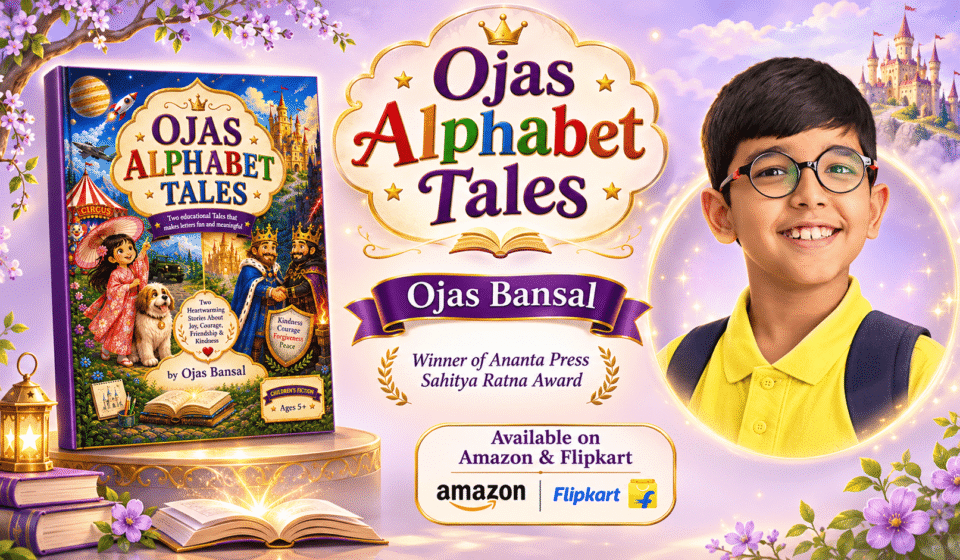
The presentation appears aware that an invitation must first catch the eye. The supplied cover is richly populated with motifs from several imaginative traditions. A striped circus tent stands near the imagery of castles and crowned figures; a rocket travels through a starry sky; a friendly dog and smiling child provide warmth near the foreground. The central title is framed like a sign announcing a great event. The art does not document individual chapters, and it would be misleading to assign specific plots to its pictures. But as design, it communicates an unmistakable idea: the reader is entering a playground of possibilities. For a book aimed at children aged five and above, that promise of play is more than decoration. It can lower the distance between a beginner and a page of unfamiliar words.
The author profile encourages a second kind of engagement, this time with the act of storytelling itself. The supplied biography describes Ojas as someone interested in discovering cultures, learning languages, sketching, and coloring. Those interests belong naturally together. A person who notices how different people live and speak accumulates material for stories; a person who draws imaginary worlds practices giving shape to ideas that do not yet exist in words. It is reasonable to see the book as part of that broad creative enthusiasm, while remaining careful not to invent details of the author’s private writing process. The visible achievement is that a young storyteller is publicly treating imagination as work worth developing.
That example carries genuine value for young audiences. Children’s literature is sometimes presented as something produced by adults and received by children. Here, readers can encounter a child on the creating side of the relationship. A young reader may not be inspired to produce fifteen books, nor should that be the expectation. They may simply realize that the story they invented during play, or the character they drew in a notebook, can be taken seriously. The book can therefore invite two complementary forms of literacy: understanding someone else’s words and finding the confidence to make one’s own. This is a meaningful contribution even for families who approach the volume primarily as an entertaining alphabet resource.
The promotional biography also lists several recognitions for the young author, including awards associated with Dubai and India. Such information adds context to the author’s public profile, but the quality of Ojas Alphabet Tales should be assessed separately from the number of accolades. A book is not effective merely because its author has been celebrated, just as a child writer should not be judged only in relation to extraordinary milestones. What deserves evaluation here is the idea on the page: whether stories support learning, whether the questions stimulate interest, whether the illustrations welcome exploration, and whether the themes provide children with something to discuss. The supplied description provides reasons for optimism, but a complete text would be needed for a definitive judgment on execution.
The themes listed in the synopsis are thoughtfully chosen for the intended audience. Curiosity encourages discovery; courage speaks to trying what feels difficult; kindness and friendship ask readers to consider others; family connects the imagined world with familiar relationships. These values are important not because a book must teach a formal moral at every turn, but because children are building language for experiences they already have. The most effective story can make a quality visible without explaining it too heavily. If a reader recognizes a feeling in a fictional character, the vocabulary of that feeling becomes easier to use. The book’s stated ambition to unite positive values with reading activities is therefore substantial, not merely ornamental.
The interactive components are equally relevant to authorship and voice. A quiz can ask a child to remember something; a good question can also invite a child to interpret it. Vocabulary challenges can support recognition, but they can also offer new materials for self-expression. A reader who learns a word and then uses it in an invented sentence has begun to cross the line from audience to creator. The supplied summary does not reveal the exact questions or difficulty levels, so those specific qualities remain unverified. Still, the combination of narrative and activity is well suited to a book interested in the joy of language. It suggests an educational experience with room for response, rather than mere passive consumption.
Another point worth appreciating is the book’s scale. Thirty-four illustrated pages may appear modest beside a longer chapter book, but brevity is not a weakness in material for beginning readers. Concision asks a creator to decide what matters: which images will draw attention, which words deserve emphasis, and when to leave space for a question. It also respects the rhythm of early reading, when a few enjoyable minutes may do more for confidence than a session stretched beyond a child’s interest. Length alone cannot prove that a book is well paced, of course. The synopsis makes clear the intended compact format, while close examination of the actual interior would be needed to judge how successfully it uses each page.
This is where a balanced appraisal is important. With only the cover and a publisher-supplied description of Ojas Alphabet Tales, a reviewer should not claim to have examined its complete plots, tested the quizzes, or compared its typography with that of similar books. Nor would it be fair to assume that every element succeeds simply because the project has an appealing purpose. Readers looking for particular phonics instruction, graded vocabulary practice, or a curriculum-aligned workbook should review sample pages before purchasing. The book’s described strengths suggest a supplementary and story-led role, rather than evidence of a complete literacy program. Clear expectations help the work reach the readers most likely to enjoy it.
What remains especially attractive is the reciprocity at the center of the project. A child author draws on imagination to reach child readers; those readers encounter words, characters, and questions that may encourage them to imagine further. It is a creative circle. The educational framework gives the experience direction, while the fantasy imagery gives it energy. In an ideal shared reading session, the book need not have the final word. A parent can ask what the child would do, a teacher can invite a new ending, and a reader can begin a tiny story of their own. The book becomes a beginning rather than a closed lesson.
Seen this way, Ojas Alphabet Tales is not significant only because of the age of the person who wrote it. Its interest comes from the alignment between its creator’s imaginative identity and its readers’ need for playful entry points into language. The author biography offers inspiration; the cover offers spectacle; the synopsis offers an educational rationale. Together, they establish a promising children’s book concept that respects both the pleasure of stories and the importance of early learning. The final measure will always be the experience of actual readers with the complete book, yet the available materials provide a strong reason to be curious about that experience.
The most worthwhile achievement of a children’s book is often invisible at the moment it happens. It occurs when a child asks for another story, invents a character while walking home, or looks at a new word and feels excitement rather than reluctance. Ojas Alphabet Tales aims toward those moments. It encourages young readers to imagine that letters can lead to adventures and suggests, through the example of its young author, that adventures can also begin in their own minds. For anyone interested in nurturing the next generation of readers and storytellers, that is an invitation with real heart.
Buy the book on Amazon: https://www.amazon.in/Ojas-Alphabet-Tales-Bansal/dp/B0HLXNHBXV/