Book Review – Zindagi Ke Samose, Hansi Ki Chatni by Sandeep Shanker: Hindi Humour Across Two Scripts

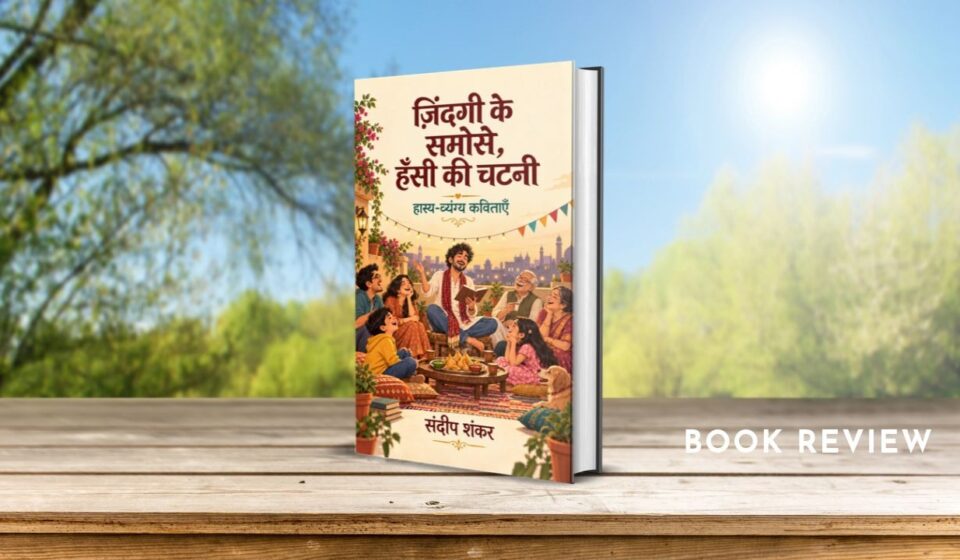
The most consequential editorial choice described for Zindagi Ke Samose, Hansi Ki Chatni concerns who should be able to read it. Sandeep Shanker’s collection is written primarily in Hindi using Devanagari and is also presented in Roman-script Hinglish for people who understand Hindi. This gives its humour an explicitly inclusive intention. The reader’s familiarity with a particular alphabet need not be the only route into the work. For a collection combining satire, amusement and story-like poems, that decision is closely connected to the substance of the project. A joke depends on being understood, and understanding begins with access to the words.
The distinction between language and script matters here. A Hindi-speaking person may be more comfortable reading one script than another; presenting the language in Roman letters addresses that possibility. The supplied description calls this version Hinglish, but it does not establish that the poems have been translated into English. Treating the two as equivalent would misrepresent the book’s stated purpose. Its invitation is directed towards a broader range of people who understand Hindi. That is a specific editorial aim, and it deserves recognition on its own terms rather than being expanded into unsupported claims about translation or an international readership.
Such a presentation also raises interesting questions about a poem’s relationship with its reader. The visual familiarity of words can influence how easily someone enters a passage, while the humour may depend on the sound or suggestion of an expression. A second script offers another path to that encounter. It also creates practical decisions about spelling and ease of recognition. These are considerations inherent in the format, not evidence of how the book has resolved them. Without parallel samples, the consistency of the Roman-script presentation cannot be assessed. Its underlying intention nevertheless gives the collection a clear reader-oriented rationale.
The narrative character of the poems introduces a further question of craft. A story needs enough context for an event to matter, while a poem requires decisions about emphasis and what to leave unsaid. Humorous writing adds a concern with when the reader receives a particular piece of information. The combination can be demanding because explanation may make an incident clear while reducing its surprise. Shanker’s project is interesting at this meeting point. Its stated form suggests a willingness to work with the momentum of an anecdote inside verse, where the arrangement of a detail can influence both meaning and amusement.
Satire brings a different kind of clarity into the discussion. Readers need some sense of what an observation is questioning, particularly when an amusing incident carries a critical implication. Too much explanation can make a poem sound instructional; too little can leave its intention uncertain. The book’s description identifies satire as one of its ingredients and includes the aim of helping readers smile at themselves. Together, these intentions suggest that the critical gaze can turn towards the audience as well as its subjects. The actual sharpness and fairness of that gaze remain matters for the poems themselves to establish.
Shanker’s range of interests gives those formal choices recognisable material to work with. His biography mentions everyday experiences, childhood recollections, school and college days, food and amusing stories. For a writer, the challenge is to decide what the reader needs to know about an occasion that the writer already understands. Private associations cannot simply be assumed. A successful telling must make the relevant detail available on the page. This is a useful way to approach the collection’s premise: its accessibility depends partly on script, and also on the writer’s ability to make a personal observation intelligible beyond its original setting.
Accessibility also has a literary dimension beyond the choice of letters. Clear language can leave room for a reader’s interpretation, and a recognisable incident can raise a question without stating its answer. The book’s combination of humour and satire makes that openness particularly relevant. Readers may arrive at an amusing observation quickly and then spend longer considering what it implies. A welcoming presentation should make that encounter possible without deciding every response in advance. This is a useful standard for the project Shanker describes: the aim of reaching more readers can coexist with an interest in the different meanings they bring to a poem.
The coexistence of the two scripts should also be understood as a choice offered to the reader. The stated intention is to help more people who understand Hindi enjoy the collection, so a preference for either presentation need not carry a judgement about literary seriousness. A reader’s starting point can simply be the form that feels comfortable. This gives the format a useful practical focus. Attention can turn towards the incident being told or the observation being made, rather than remaining fixed on difficulty with the script. The project’s inclusive purpose is clearest when considered through that ordinary experience of choosing how to read.
Readers best placed to appreciate this project may include people curious about Hindi poetry who prefer Roman letters, as well as readers already comfortable with Devanagari and interested in humorous narrative verse. These are potential audiences suggested by the stated format, rather than evidence of actual reception. Their needs will not be identical, which makes the editorial ambition worthwhile. Ease of entry should allow each reader to concentrate on an observation and its effect. The book’s promise is therefore best understood as an effort to bring language, presentation and familiar subject matter into a practical relationship with its audience.
Viewed through that lens, Zindagi Ke Samose, Hansi Ki Chatni offers a thoughtful concept for a humour collection. It recognises that people can share a language without sharing the same reading habits, and it chooses a presentation intended to accommodate that difference. Its literary ambition connects accessibility with narrative verse and the questioning impulse of satire. Those elements give a reader several reasons to approach the work, from curiosity about the form to an interest in a familiar situation seen differently. Shanker’s invitation is clear: enter through the script that suits you, and bring your own understanding of everyday life to the encounter.