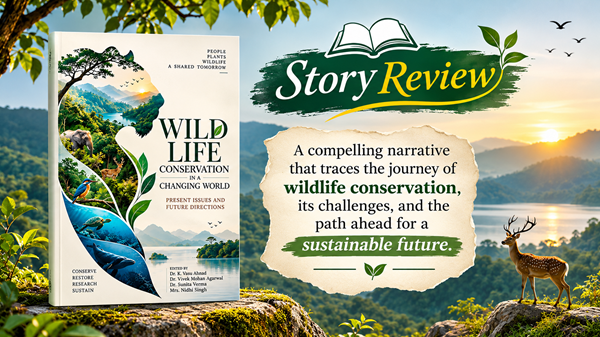
When Nature Struggles to Survive: A Story Review of Wild Life Conservation in a Changing World

Story Review
Every forest has a story. Every river carries a history, and every species plays a role in maintaining the delicate balance of life on Earth. Yet across the world, these natural stories are being interrupted by habitat destruction, climate change, biodiversity loss, and the expanding influence of human activities. Wild Life Conservation in a Changing World: Present Issues and Future Directions, edited by Dr. K. Venu Achari, Dr. Vivek Mohan Agarwal, Dr. Sunira Verma, and Ms. Nidhi Singh, brings attention to these environmental challenges and the urgent need to reconsider humanity’s relationship with nature.
Although the book is an interdisciplinary scientific volume rather than a conventional fictional narrative, its central subject reveals a compelling real-world story: the struggle to preserve wildlife and ecological balance in a rapidly transforming environment.
Imagine a forest that has supported countless species for generations. Birds move between trees, mammals travel along familiar routes, insects contribute to pollination, and plants sustain complex ecological relationships.
Now imagine that same forest gradually divided by roads, development, and changing land-use patterns.
What was once a connected ecosystem becomes a collection of isolated habitats. Wildlife movement becomes difficult, access to food and breeding areas may decline, and ecological relationships begin to change.
This is one of the realities that makes wildlife conservation such an important subject.
The book’s emphasis on habitat degradation and fragmentation encourages readers to understand how environmental changes can affect entire ecosystems rather than individual species alone.
The challenges facing wildlife do not end with habitat loss.
Climate change introduces additional uncertainty by influencing temperatures, rainfall patterns, seasonal cycles, and the availability of natural resources.
Species adapted to particular environmental conditions may struggle when those conditions begin to change. Ecosystems that once appeared stable can become increasingly vulnerable.
Through its focus on ecological change and climate-adaptive conservation, the volume draws attention to the importance of preparing for environmental challenges that may develop over years or decades.
The message is clear: protecting wildlife requires understanding both present threats and future ecological risks.
Amid these challenges, the book introduces an important source of hope: scientific knowledge.
Research, ecological monitoring, field observations, and evidence-based management can help conservation professionals understand what is changing and determine how to respond.
Long-term biodiversity monitoring can reveal trends that short-term observations may overlook. Ecological restoration can help recover damaged habitats, while landscape connectivity can improve the ability of wildlife to move across fragmented environments.
The volume’s emphasis on scientific research demonstrates that meaningful conservation requires continuous learning.
Nature is dynamic, and successful environmental management must be capable of adapting to new evidence and changing circumstances.
One of the most meaningful aspects of the book’s central message is the recognition that people are part of the conservation story.
Communities living near forests, wetlands, and wildlife habitats often have close relationships with natural resources. Their knowledge, participation, and cooperation can contribute to more practical and sustainable conservation outcomes.
The volume’s interest in community-based conservation highlights the importance of combining scientific expertise with local involvement.
Conservation cannot always be achieved simply by establishing protected boundaries. Lasting success also depends on public awareness, inclusive decision-making, responsible resource management, and environmental policies informed by sound evidence.
This broader perspective encourages readers to recognize wildlife protection as a shared responsibility.
The most compelling element of Wild Life Conservation in a Changing World is its focus on the future.
The book encourages researchers and conservation practitioners to identify emerging threats, investigate unanswered questions, and develop innovative approaches to biodiversity protection.
Rather than treating conservation as a completed task, it presents the subject as a continuing process requiring cooperation, scientific progress, and long-term commitment.
Its discussion of ecological restoration, adaptive management, and inclusive governance reinforces the possibility of building more resilient ecosystems.
Final Reflection
Wild Life Conservation in a Changing World: Present Issues and Future Directions invites readers to look at environmental conservation not merely as a scientific discipline but as an essential responsibility toward the natural world and future generations.
The volume connects ecological challenges with practical possibilities, emphasizing that the future of wildlife depends on the choices made today.
Through its interdisciplinary vision, the editors highlight the importance of research, public participation, environmental awareness, and thoughtful management.
The central message extends beyond wildlife scientists and policymakers. It speaks to everyone who recognizes the value of forests, rivers, oceans, and the extraordinary diversity of life they support.
Ultimately, the story of wildlife conservation is also the story of humanity’s future. Protecting biodiversity means safeguarding the ecological relationships that make life possible.
And the next chapter of that story is still being written.