Book Review—Dear 25, Love 75 by V. K. Soni: Wisdom in the Small, Unplanned Moments of Life

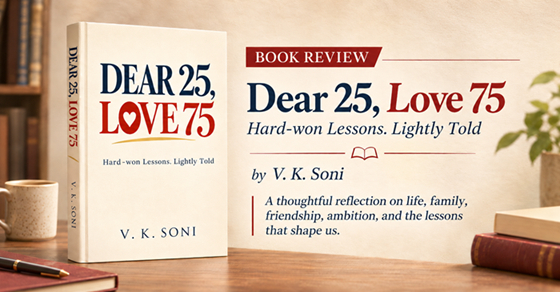
DEAR 25, LOVE 75 • Hard-won Lessons, Lightly Told
Vijay Kumar Soni | First edition, November 2026 | ISBN 978-81-6652-119-5
It is easy to imagine that the older version of ourselves possesses a neat set of answers: which risks were worth taking, which mistakes should have been avoided, and which achievements mattered most. Vijay Kumar Soni’s Dear 25, Love 75: Hard-won Lessons, Lightly Told takes a more entertaining view. Written as twenty letters from seventy-five to twenty-five, the book looks back across five decades without pretending that experience eliminates uncertainty. Soni is interested in the distance between what a young person expects from life and what time eventually teaches. His preferred tools are affectionate teasing, carefully observed memories, and the willingness to laugh at his own former confidence.
The format is central to the appeal. Each letter addresses a younger self, yet the voice feels open enough to include readers of any age. In ‘Before We Begin,’ Soni suggests approaching the book less as a conventional memoir or a rule book than as an informal conversation with someone who has travelled further along the road. That distinction matters. The letters do recount personal experiences, but their purpose is not to build a grand narrative of professional accomplishments. Instead, familiar events become starting points for reflection. Readers are free to take the letters one at a time, in any order, which suits the small, self-contained stories and the conversational rhythm.
Some of the book’s most successful moments arise from the contrast between everyday pleasure and the perspective that aging brings. ‘Parathas – A Love Story’ begins with a bowl of oats after gallbladder surgery and becomes a funny, unexpectedly tender reflection on appetite, health, marriage, and gratitude. Memories of beloved parathas sit beside the practical care of Madhumati, the author’s wife. What might have become a predictable lesson about sensible eating instead recognizes how food can hold family history and affection. Similarly, ‘The Body Has a Memory Too’ uses youthful excess and physical consequences to make a serious point about looking after oneself without losing the book’s lively, self-mocking tone.
Relationships give the collection much of its emotional weight. In ‘The Woman Who Has Known All My Versions,’ the author reflects on a marriage shaped not only by milestones but also by ordinary routines: shared snacks, daily journeys, disagreements, care, and years of changing circumstances. The strongest observation is that people in lasting relationships come to know multiple versions of one another. Elsewhere, the chapters on his daughters examine the difficult parental lesson that children must make their own decisions. ‘Four Toys’ returns to the competing demands of work and family life. These pieces do not offer idealized portraits of perfect relationships. Their warmth comes from acknowledging the awkward, comic, and imperfect ways people remain connected.
The professional and educational episodes are equally varied. ‘Lessons I Never Learned in a Classroom’ challenges the idea that formal education alone prepares us for the world, while ‘The Rs. 1,200 Education’ treats an expensive mistake as the price of understanding something important. In ‘The Man Who Couldn’t Speak—Until He Did,’ Soni considers confidence and the effort required to develop it. Other accounts, including ‘The Wrong Answer Was Right’ and ‘The Adventures of Mr P’, look at judgment, projects, and the gap between plans and outcomes. The author has an engineer’s instinct for systems, but he is especially alert to the human element that no system can completely predict.
One pleasure of the reading experience is the author’s willingness to follow apparently minor memories. ‘When the Cobra Heard Binaca Geet Mala,’ ‘The Rat Was Not on the Menu,’ and ‘Bollywood Calling’ signal the range of adventures and mishaps that enter the letters. These stories create variety while illustrating a consistent idea: an event need not seem important when it happens to become memorable later. The lightness is not merely decorative. It lowers the distance between writer and reader, so the reflections feel earned through experience rather than delivered as instructions. The jokes often land because Soni is willing to make himself their target.
As the collection moves towards later-life questions, its perspective becomes especially relevant to contemporary readers. ‘From Fire to Mouth—Ears Open to Ears Closed’ considers how technology can change the texture of family conversation, while ‘The Most Valuable Asset You Can Create’ places lasting friendships ahead of more obvious material measures of wealth. My Twenty-Year-Old Excel System brings financial awareness into a book otherwise full of food, family, travel, and personal encounters. These are not unrelated detours. Together they suggest a wider understanding of a successful life, one measured through relationships, self-knowledge, attention, and the ability to make practical choices over time.
Soni’s writing has a recognizable rhythm: a small incident, a surprising complication, a humorous observation, and a quieter conclusion that offers perspective. The familiar ‘Dear 25’ and ‘Love, 75’ framing makes each chapter feel personal. The prose often adopts the vocabulary of meetings, records, accounts, and engineering to describe human experiences, creating an amusing contrast between technical precision and the disorder of life. Readers seeking a tightly argued academic work or a conventional step-by-step self-help manual should adjust their expectations. The book’s insights arrive through anecdotes, and their force depends on whether a particular memory resonates with the reader.
There is also a useful restraint in the way the older narrator addresses youth. He does not argue that seventy-five automatically understands everything or that the younger generation must repeat his choices. The closing reflections leave room for different answers and different lives. That openness makes the letters more credible. It is possible to enjoy the stories without adopting every interpretation, and the book often seems to invite exactly that kind of conversation. The voice is grounded in one man’s experiences, not presented as a universal template. Its best passages offer recognition rather than certainty: the reader may remember a similarly ordinary event that only later acquired meaning.
Dear 25, Love 75 is likely to appeal to readers who enjoy reflective non-fiction, personal essays, intergenerational conversations, and humor rooted in everyday life. Younger readers may find reassurance that confusion and mistakes are not unique to their generation. Older readers may recognize the changing values that come with hindsight. Across the letters, the book returns to a generous idea: achievements matter, but the people who stay, the health we take for granted, the friendships we nurture, and the ordinary moments we notice can matter at least as much. Its appeal lies not in grand pronouncements but in the comfort of a seasoned voice that still finds life surprising.
Amazon Link:https://www.amazon.in/Dear-25-Love-75-Hard-won/dp/B0HQ6PRXW3