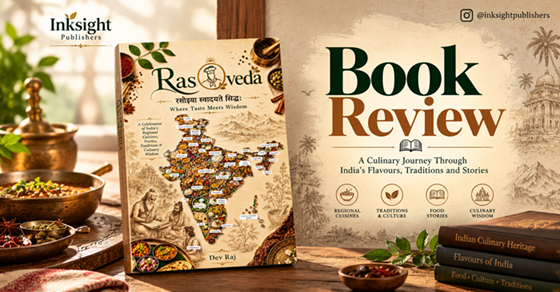
Book Review – Rasoveda by Dev Raj: Preserving Culinary Knowledge in a Changing India

BOOK REVIEW | DEV RAJ
Culinary heritage is often discussed through nostalgia, yet preservation requires more than affection for familiar flavours. It depends on how carefully knowledge is identified, explained and passed forward. Chef Dev Raj’s Rasoveda enters this conversation with a clear proposition: regional cooking is a form of cultural knowledge, and its recipes, techniques and ingredients deserve to be documented together with their histories. Described as a culinary journey through India, the book draws attention to the relationships among place, practice and meaning. Its central interest is not simply the finished dish but the knowledge that makes that dish possible. This positions Rasoveda as a relevant contribution to broader discussions about cultural continuity and culinary education.
India’s food culture resists easy generalisation. A regional approach must recognise that the traditions of Punjab and Awadh do not share a single culinary vocabulary with Bengal, Gujarat, Maharashtra, Kashmir or Kerala. Rasoveda sets out to travel across these distinctive food landscapes, including the coconut-rich heritage of southern India. The breadth of that undertaking is notable because public conversations about Indian cuisine often privilege a few familiar dishes while overlooking the many systems of ingredients and preparation through which regional identities are expressed. The book’s declared scope encourages a more precise understanding of diversity, one that recognises both regional character and the historical influences that continue to shape food.
The emphasis on traditional cooking methods is especially significant. Techniques are repositories of practical reasoning: they reflect available fuel, local produce, desired textures, food customs and accumulated experience. When those methods are separated from their settings, a recipe can become reproducible without remaining fully understandable. By bringing stories and techniques into the same frame, Rasoveda suggests that preserving food culture also means preserving explanation. This is a useful perspective for contemporary readers who encounter instructions rapidly through digital platforms but may have fewer opportunities to learn from sustained observation in homes or working kitchens.
Chef Dev Raj’s professional background informs the book’s stated orientation. His experience spans Indian regional cooking, Sattvik and wellness-oriented food, menu development, research and development, consultancy, training and professional kitchen operations. Such experience offers an identifiable reason for the book’s attention to both tradition and contemporary application. It also makes the volume relevant beyond the home kitchen. Hospitality teams and culinary educators need language for communicating differences in regional methods, while menu developers face questions about how heritage may be presented in evolving settings. The book’s professional lens promises to make these connections accessible without treating cuisine as a merely commercial product.
The inclusion of regional thalis provides another productive framework. A thali is not only an arrangement of individual preparations; it can prompt readers to consider how dishes relate to one another and how eating customs shape a meal. In a study of regional cuisines, this perspective can help counter the habit of isolating one signature dish as the representative of an entire place. Rasoveda’s wider attention to ingredients and historical culinary influences likewise invites readers to consider the relationships behind flavour. The value of these ideas lies in seeing a cuisine as a system of knowledge, not simply a catalogue of recipes.
Any publication with such broad geographical ambition must negotiate the limits of coverage. Regional traditions include variations across communities, households and changing generations. Consequently, no singular description can stand in for every cook or every interpretation of a dish. The most responsible way to read Rasoveda is as a structured invitation to further learning rather than an exhaustive census of Indian food. This distinction matters editorially. It allows the volume’s strengths—range, cultural purpose and professional perspective—to be appreciated without assuming a completeness that the supplied description does not claim.
The language of heritage can sometimes imply that authenticity belongs only to the past. Rasoveda’s description offers a more useful balance: it is rooted in tradition while presented through a contemporary professional perspective. That balance can open constructive questions about change. How should a technique be explained to someone outside its original context? What is retained when a preparation moves from a household to a professional kitchen? How can innovation draw from inherited knowledge without erasing it? These are questions a work of this kind encourages readers to ask, even where it does not promise a single settled answer.
The author’s stated philosophy provides a coherent foundation for this approach. His belief that understanding a dish’s story helps illuminate its culture links the act of cooking to a wider set of responsibilities: attentive research, respect for regional distinction and thoughtful communication. It is a constructive frame for culinary professionals in particular. Technical competence is essential, but cultural literacy can deepen that competence and improve the way knowledge is shared with students, colleagues and diners. The book’s perspective thus makes sense within culinary training and food research as much as within leisure reading.
Rasoveda’s potential readership is correspondingly broad. Curious home cooks can find motivation to look past familiar recipes; culinary students can consider why ingredients and methods must be understood in context; hospitality professionals may value its emphasis on regional identity; and general readers can encounter Indian food as an expression of history and community. Its promise is not novelty for novelty’s sake. Rather, it is the more durable work of connecting taste with memory, method with meaning and professional practice with cultural care. On the information available, that is a thoughtful and timely basis for a book about India’s many culinary traditions.
Amazon Link – https://www.amazon.in/RASOVEDA-Where-Taste-Meets-Wisdom/dp/9379000693/