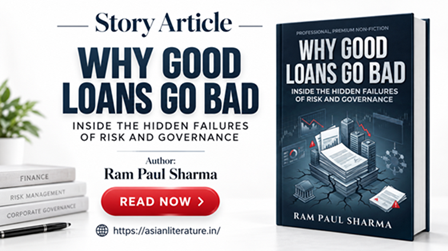
Why Good Loans Go Bad – Inside the Hidden Failures of Risk and Governance by Ram Paul Sharma

The book explains how a loan that looks completely safe in the beginning can later become a serious problem. It is not always because the borrower suddenly fails. Many times, the signs were already there. The problem is that institutions, managers, teams, or systems may fail to notice them properly or may not act on them at the right time.
What makes this book interesting is that it does not talk only about numbers, reports, or financial ratios. It also looks at human behaviour, office culture, governance, internal systems, and decision-making. This gives the book a wider and more realistic approach. It shows that even strong-looking institutions can make mistakes when people stop asking questions or become too comfortable with old assumptions.
One of the strongest points in the book is the idea of an “illusion of safety.” Sometimes everything looks normal on paper. Payments are coming, reports are clean, and no major problem is visible. But underneath this calm surface, risk may already be increasing. By the time the problem becomes clear, it may already be too late.
The book also highlights the importance of governance. Good governance is not only about having rules and policies. It is about making sure that people follow them honestly and responsibly. It is also about accountability, proper monitoring, and giving importance to warning signs. If people are afraid to raise concerns or if senior decisions are never questioned, then even a well-designed system can fail.
Another good thing about this book is that the message is easy to understand. The topic is serious, but the central idea is very practical. It makes the reader think about how financial decisions are actually made and where things can go wrong.
This book can be useful for bankers, finance professionals, risk managers, auditors, students, and even general readers who want to understand how lending failures happen. It gives a different view of bad loans by showing that failure is often not one big mistake. It can be the result of many small ignored signals.
Overall, Why Good Loans Go Bad is a thoughtful book that reminds us of one important lesson: problems usually give warnings before they become disasters. The real challenge is whether we are willing to notice those warnings and act on them in time.