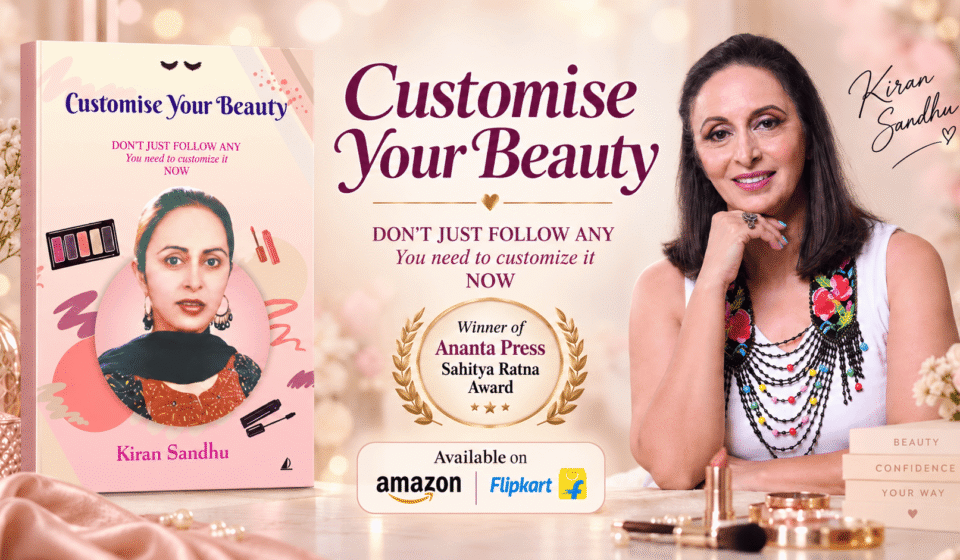

Some books about beauty are highly specialized. They may focus entirely on makeup artistry, dermatological skincare, fashion styling, or natural remedies. Kiran Sandhu’s Customise Your Beauty takes a broader route. It brings several areas of personal appearance and self-care into one guide and connects them through a single principle: beauty works best when it is adapted to the individual. That makes the book particularly appealing to general readers who want to understand how different parts of beauty fit together rather than study one subject in isolation.
The book begins from a reality that many readers will recognize. People often buy a product because it is heavily advertised, try a makeup trend because it looks impressive online, or purchase an outfit because it is fashionable, only to discover that the result does not feel right. Sandhu explains this not as personal failure but as a mismatch. Different skin types respond differently. Different facial structures require different techniques. Different body shapes interact differently with clothing. Different skin tones and undertones are complemented by different colours. Once these differences are understood, beauty becomes less about luck and more about informed choice.
This is why the book works well as an introductory handbook. It encourages readers to begin with basic observation. What is my skin type? What is my face shape? What are the characteristics of my eyes? What is my body shape? Which colours harmonize with my natural colouring? What ingredients should I look for when choosing cosmetics? These are foundational questions, and answering them can make later decisions easier. The reader is not expected to become a professional stylist or cosmetic chemist. Instead, she is encouraged to develop enough understanding to navigate everyday choices with more confidence.
The skincare content is a strong example of this reader-friendly approach. Sandhu does not frame skincare as a competition to own the most products. She emphasizes the importance of selecting products and ingredients according to individual needs. This is helpful because many people build routines by accumulation: they add whatever is currently popular without asking whether the new product has a clear purpose. The book encourages the opposite habit. Understand the skin first, then decide what might support it. This philosophy can simplify routines while making them more intentional.
Makeup is also presented through understanding rather than imitation. The book discusses the importance of face shape and eye characteristics in determining how makeup techniques will appear. This can be genuinely useful for readers who have struggled to reproduce tutorials. A line, contour, or placement that works on one face may need adjustment on another. Sandhu’s advice effectively gives permission to adapt. Instead of seeing a tutorial as a strict formula, readers can treat it as a starting point and modify it according to their features.
The section on body shape and clothing expands the book beyond the dressing table and into the wardrobe. Sandhu explains that different cuts and designs can flatter different proportions. The example of an apple-shaped body illustrates how clingy clothing, certain necklines, low pants, or thick belts can change the visual effect of the figure. The real lesson is broader than any single list of dos and don’ts: proportion matters. Once readers understand how garment lines interact with their body, they can make more confident choices and rely less on impulse purchases.
Colour selection adds another practical layer. Many people know instinctively that some colours make them look brighter while others seem to drain the face, but they may not understand why. By introducing warm and cool undertones and the relationship between colouring and clothing, Sandhu gives readers a vocabulary for that experience. This can make wardrobe building more coherent and can also influence makeup choices. A person who understands her colouring can select shades with a clearer sense of how they will relate to her complexion.
Home remedies and beauty recipes provide variety and accessibility. Sandhu’s lifelong interest in beauty included personal experimentation with both natural and commercial approaches, so these sections feel consistent with her background. Readers who enjoy preparing simple treatments at home may find this especially appealing. More importantly, it keeps the book from implying that good self-care always requires expensive purchases. The presence of home-based options reinforces the idea that beauty is a practice, not merely a shopping category.
Sandhu’s professional work in naturopathy and wellness also gives the book a holistic edge. Her author profile describes a belief that beauty, skincare, and self-care should be understood in relation to the individual. This philosophy extends to the book’s discussion of weight management. Although health and weight are complex subjects that may require guidance from qualified professionals, Sandhu’s broader point is consistent: personal plans should reflect personal needs rather than be copied without thought. Readers can take from this the useful habit of questioning universal formulas.
A significant strength of Customise Your Beauty is its potential to grow with the reader. Someone may initially open the book because she is interested in skincare, then later return to sections on colour, clothing, makeup, or home remedies. Because the book spans several connected areas, different chapters may become useful at different times. This gives it more lasting value than a guide tied to one temporary trend.
The book is also notable for the way it treats individuality as an advantage. Beauty culture can often make difference feel inconvenient: if a product or trend does not work, the consumer may assume she is the problem. Sandhu reverses that logic. The fact that people are different is exactly why beauty should be customized. This message can be especially encouraging for readers who feel that standard advice rarely seems designed for them.
From a reader’s perspective, the book’s uniqueness lies in its integration. Skincare, cosmetics, facial structure, clothing, colour, DIY care, and personal wellness are not presented as unrelated subjects. They are different expressions of the same central skill: learning to see yourself accurately and make choices from that knowledge. That coherence gives the book identity. It is not just a collection of beauty tips; it is a guide to building a personal beauty system.
Kiran Sandhu’s long-standing engagement with beauty adds credibility to that system. Her interest began around the age of thirteen or fourteen and developed over decades through learning, observation, experimentation, natural therapies, home remedies, and cosmetic products. She is also associated with SKIIN Beautty Essence, which reflects her continuing professional involvement with skincare and personal care. This background gives the book a personal foundation. The advice grows from sustained interest rather than a brief fascination with the subject.
For general non-fiction readers, Customise Your Beauty is approachable because it deals with recognizable problems and choices. It is especially suitable for someone who wants to become more confident in selecting products, dressing for her proportions, understanding colour, or adapting makeup to her features. Its greatest strength is not that it provides one perfect routine. It is that it explains why there should not be one perfect routine for everyone.
The book’s lasting message is therefore simple and useful: beauty becomes more effective when it becomes more personal. By replacing blind following with observation and customization, Sandhu encourages readers to develop a style of self-care that is informed, flexible, and individual. For anyone interested in beauty without wanting to be controlled by every new trend, this is a thoughtful and practical guide.
Amazon: https://amzn.in/d/01hSkygC