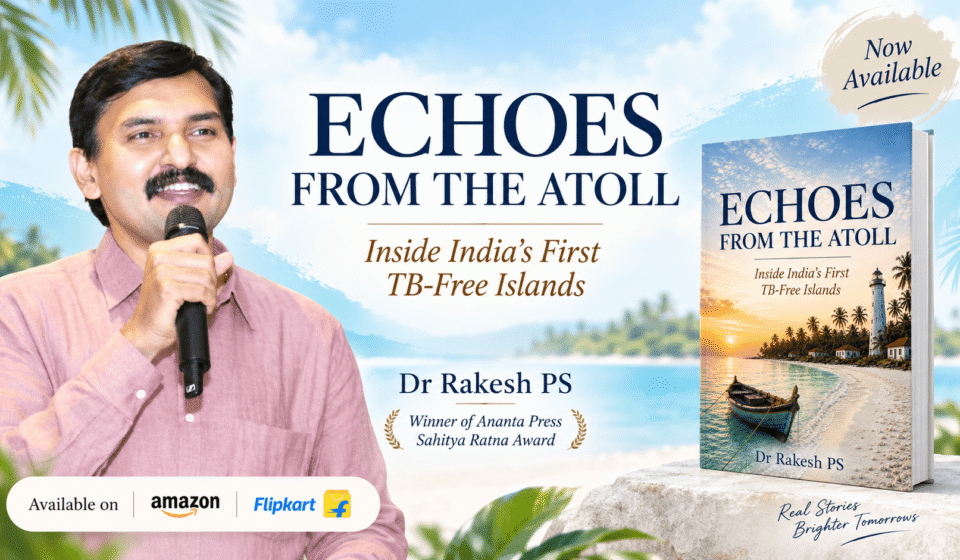

Echoes from the Atoll: Inside India’s First TB-Free Islands is the kind of nonfiction book that demonstrates why storytelling matters even in fields built on evidence. Dr Rakesh PS is a scientist, physician and public health professional whose career has been shaped by research, disease prevention, health systems and field practice. Yet in this literary memoir, he steps beyond the conventional vocabulary of public health and enters a more reflective form. The result is a book that asks readers not only to understand an achievement, but to remember the people and place behind it.
This is a significant creative choice. Public health generates enormous quantities of information: surveillance data, programme reports, research papers, monitoring indicators, guidelines and evaluation documents. These are essential. They help professionals decide what works and what must change. But they are poor containers for memory. They cannot fully preserve atmosphere, personal transformation, uncertainty, affection, cultural tension or the feeling of moving through a place that is physically and socially unlike most other settings.
A literary memoir can do what a report cannot. It can slow down. It can notice. It can make room for the emotional consequences of work. Echoes from the Atoll appears to use that freedom to revisit Dr Rakesh’s years in Lakshadweep not simply as a completed professional chapter, but as an experience that continued to resonate.
The title captures this beautifully. “Echoes” suggests memory returning across distance and time. An “atoll” grounds that memory in a specific geography. Together, the words convey the basic tension of memoir: the author is no longer fully inside the original moment, but the moment continues to speak. The book seems to be written from that space of return.
Lakshadweep gives the narrative its physical form. The sea is not just an image of beauty; it is an organising reality. Islands must be reached. Weather matters. Distances affect movement. Healthcare delivery must respond to geography. These details give readers an understanding of public health that is both practical and literary. The environment shapes the plot because it shapes what can happen.
This treatment of geography is one of the book’s strongest qualities. In many forms of nonfiction, place is reduced to a name. Here, place influences relationships, systems and identity. A health worker on an island is not operating in the same conditions as a worker in a dense mainland city. A patient’s access to care is shaped by different constraints. A professional travelling between islands experiences time and distance differently. The reader begins to understand why the health system itself had to be designed around the local world.
The story of tuberculosis elimination unfolds within this setting, but it does not overwhelm it. Instead, the public health achievement becomes part of a larger meditation on collective action. The people who carried the effort – ASHAs, health workers, families and community leaders – become more important than the mechanics of the programme. This is a wise narrative decision because it reflects the reality that systems succeed through people.
Dr Rakesh’s stated belief that behind every statistic is a human being becomes especially meaningful here. Statistics are often seen as objective and stories as subjective, but the two need not be enemies. Statistics tell us how many. Stories help us understand what it meant. A responsible public health narrative needs both. Echoes from the Atoll chooses to focus on the side that technical literature too often leaves out.
The author is uniquely positioned to make this move. He has spent more than fifteen years in public health and has authored more than 150 scientific publications. He therefore knows the strengths and limitations of academic forms. His previous writing, including health education materials and his book on outbreak investigations, already points toward an interest in making professional experience accessible and human. This memoir represents a further step: the subject is no longer primarily a technical problem, but a relationship between person, place and community.
That evolution is interesting in itself. Professionals often become more specialised as their careers progress. Dr Rakesh’s writing appears to move in the opposite direction in terms of audience. The deeper his experience becomes, the more he seems interested in communicating beyond the boundaries of his profession. This is valuable because some of the most important lessons in health – trust, empathy, collective responsibility, local knowledge – belong to everyone.
The memoir’s exploration of tradition and modernity broadens its literary interest further. Lakshadweep is shown as a community experiencing change. The narrative is sensitive to the fact that change can be desired and feared at the same time. New opportunities may coexist with concern about what is being lost. Modern aspirations may challenge older rhythms without completely replacing them. This ambiguity gives the book emotional maturity.
Rather than presenting heritage as something static, the memoir seems to ask how identity survives through adaptation. This question matters in many societies, but island communities make it particularly visible. Physical boundaries can create strong cultural continuity, while increased connection to wider worlds can accelerate change. The reader is invited to consider what a community chooses to preserve, what it lets go and how it defines itself while doing so.
The theme of belonging connects these social changes with the author’s personal journey. Dr Rakesh did not grow up in Lakshadweep, yet years of work and relationships created a deep attachment. His perspective therefore sits between insider and outsider. He can be moved by the islands while remaining aware that his belonging is different from that of people whose families and identities are rooted there.
This in-between position can be extremely productive in memoir. It creates curiosity without total unfamiliarity and affection without claiming ownership. The author can notice what long-time residents may take for granted, but he can also recognise that his understanding is partial. When handled with humility, this perspective allows the reader to enter the setting alongside him.
The book is also notable for how it reframes the idea of public health achievement. The phrase “TB-free” sounds final, but elimination work is never simply a finish line. It depends on continued vigilance, systems and community confidence. By embedding the achievement in a story about people and change, the memoir avoids treating certification as a trophy detached from the life around it. The milestone becomes meaningful because it reflects what a community managed to do together.
The global release of the book by Dr Lucica Ditiu, Executive Director of the Stop TB Partnership, in the presence of global health leaders, gives the memoir a strong symbolic context. A local island story enters a global conversation. Yet the book’s emphasis remains properly grounded. It reminds readers that global health is not ultimately carried out in conference rooms or policy documents. It happens in households, clinics, boats, communities and conversations.
That contrast is one of the most compelling aspects of the book. The scale of the ambition is global – ending tuberculosis – but the scale of the action is intimate. A person speaks to another person. A worker returns to a family. A community leader lends support. A health system adapts to a local constraint. A professional learns from a place. The enormous goal is built from small interactions.
For readers who enjoy memoir, this is a book about how work can change the worker. For readers interested in travel, it offers Lakshadweep as a lived environment rather than a destination. For readers interested in public health, it offers an example of community ownership and context-sensitive service. For readers concerned with social change, it examines the uneasy meeting of heritage and modern aspiration.
This ability to speak to several audiences without losing coherence is part of the book’s uniqueness. It is not a technical monograph disguised as popular writing, nor is it a travel memoir that uses health merely as background colour. The different strands appear organically connected because they all arise from the same lived experience.
The book also carries an implicit argument for a more humane kind of expertise. Expertise is sometimes imagined as emotional distance, but the memoir suggests that professionals can remain rigorous while also being moved by the people they serve. In fact, the willingness to listen and care may improve understanding. Empathy does not replace evidence; it helps evidence become relevant to real lives.
That message is especially timely in an era when institutions often struggle to communicate trust. Numbers alone rarely persuade communities. People want to understand who is speaking, why a recommendation matters and whether their own experiences are being respected. A book like Echoes from the Atoll helps bridge the gap between technical knowledge and lived reality by showing how one professional learned to see both.
The final value of the memoir lies in remembrance. Public health achievements can disappear quickly from public attention once the next crisis begins. The people who made them possible may never be widely known. By writing this story, Dr Rakesh preserves a collective effort in a form that can travel beyond professional circles and beyond the moment of certification.
Echoes from the Atoll is therefore more than an account of India’s first TB-free islands. It is an argument, made through narrative rather than theory, that evidence and empathy belong together. It shows that places shape professionals, communities shape programmes and stories shape what societies remember.
Readers looking for nonfiction with intellectual substance and emotional warmth will find much to appreciate here. The book invites us to see a health milestone from a different angle: not as the end of a programme, but as the echo of countless human actions. In that sense, its most enduring subject is not tuberculosis at all. It is the relationship between people, place and the possibility of change.Amazon Link: https://www.amazon.in/Echoes-Atoll-Inside-TB-Free-Islands/dp/9375002454