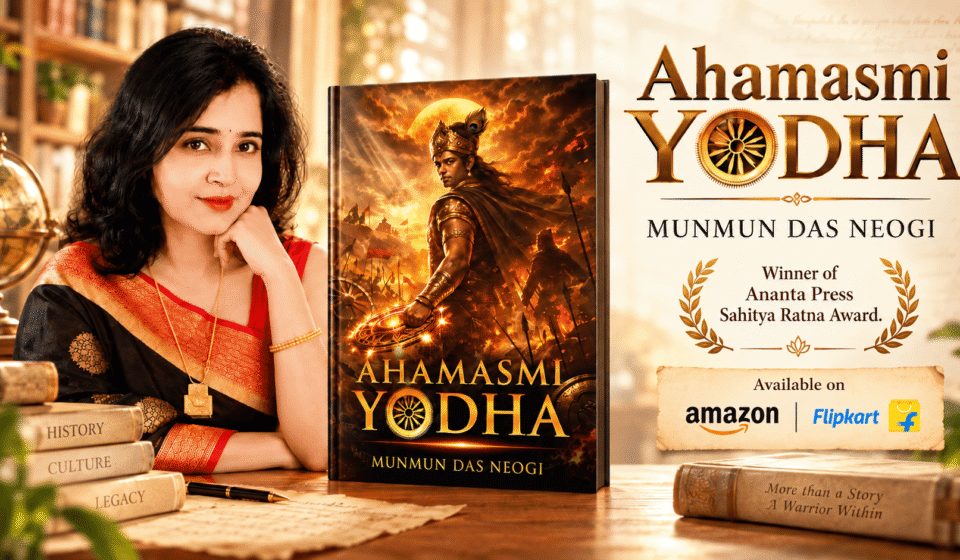

The self-help and motivational category is crowded with books that promise confidence, discipline, success, productivity, fearlessness, or personal transformation. Ahamasmi Yodha: When the God Chooses to Be a Warrior enters this space from a very different direction. Munmun Das Neogi does not begin with habits, targets, or techniques. She begins with Krsna and with a moral problem: what does a person do when peace fails, uncertainty remains, and responsible action can no longer be postponed? From that question, the book develops a motivational philosophy centred on Dharma, courage, clarity, and self-mastery.
This gives Ahamasmi Yodha a moral compass that many motivational works lack. Motivation by itself is neutral. A person can be highly motivated toward a selfish, destructive, or unethical goal. The book therefore places purpose before intensity. It asks the reader to understand why an action is necessary before celebrating the strength required to perform it. That sequence is important. It makes courage accountable to Dharma. It also gives the book relevance for readers who have grown tired of motivational messages that treat every obstacle as something to crush and every doubt as weakness.
In this book’s framework, doubt is not automatically a failure. The presence of doubt can be the beginning of discernment. Krsna’s role as guide matters precisely because the person facing conflict may not initially possess clarity. The path to courage therefore involves reflection. This is more realistic than telling readers simply to “believe in themselves.” There are times when the self is confused, emotionally charged, frightened, attached, or biased. In those moments, unquestioning self-belief can be dangerous. What is needed is a deeper alignment with principle. Ahamasmi Yodha’s spiritual vocabulary gives readers a way to imagine that alignment.
The book’s most powerful motivational move is the relocation of Kurukshetra into ordinary life. The statement that the battlefield exists within every heart makes the work immediately personal. A career decision can become a battlefield. A boundary in a relationship can become a battlefield. Speaking the truth, accepting responsibility, leaving a harmful pattern, admitting an error, resisting pressure, or choosing integrity over convenience can each become a form of inner conflict. This does not trivialise the epic battlefield; rather, it shows why epic literature remains meaningful. Its external conflicts dramatise patterns that continue to exist in human consciousness.
The phrase “I am the Warrior” is therefore effective because it names a capacity the reader is asked to develop. It is not a promise that the reader will always feel strong. A warrior may still feel fear. The difference is that fear no longer receives the final vote. This is a useful distinction for personal development. Many people delay important action because they are waiting for fear to disappear. Ahamasmi Yodha suggests another possibility: clarity of purpose can coexist with fear, and action can proceed even in its presence. Courage becomes behavioural and ethical rather than merely emotional.
The book also offers a corrective to the modern tendency to confuse assertiveness with aggression. Its ideal warrior acts without hatred and without ego. Those conditions are demanding. They require the reader to examine not just what they are doing but the emotional fuel behind it. Two people can perform the same outward action for very different reasons. One may speak firmly to protect a principle; another may speak harshly to punish or humiliate. One may set a boundary to preserve wellbeing; another may use distance to control. By drawing attention to attachment and ego, the book encourages a more mature form of motivational thinking.
This is one reason Ahamasmi Yodha can be useful to readers at different life stages. Young adults may read it as an introduction to courage and identity. Professionals may find relevance in decisions involving leadership, ethics, responsibility, and conflict. Parents or caregivers may connect with the tension between protection and attachment. Spiritually inclined readers may appreciate the emphasis on Dharma and action without ego. Readers of mythology may be interested in the deliberate focus on Krsna as strategist and guide. The central framework is broad enough to travel across these contexts because it is not dependent on one narrow life problem.
The author’s background adds another interesting layer to the book. Munmun Das Neogi has spent nearly two decades in technology, including work connected with enterprise solutions and digital transformation, while also maintaining long-standing interests in literature, Indian epics, philosophy, cosmology, Vedic thought, history, relationships, and emotion. This combination of structured professional experience and reflective cultural inquiry suits the book’s project. Ahamasmi Yodha is essentially an exercise in integration: logic and faith, strategy and spirituality, ancient wisdom and contemporary dilemmas, action and inner discipline.
Her own description of writing as a responsibility is also visible in the way the book frames conflict. It would have been easy to use the warrior image for dramatic effect alone. Instead, the concept is carefully bounded by ethical language. The warrior protects. The warrior acts when necessary. The warrior seeks clarity. The warrior does not make hatred sacred. These distinctions matter in a contemporary environment where the language of “fighting” and “winning” is often used carelessly. Ahamasmi Yodha tries to recover a nobler meaning of strength: strength that serves rather than merely asserts itself.
Another quality that makes the book distinctive is its refusal to present compassion and decisive action as opposites. This is an important message for readers who have learned to associate goodness with endless accommodation. Compassion without boundaries can become self-erasure. Patience without discernment can become avoidance. Peace without justice can become silence in the face of harm. The book’s Krsna-based framework suggests that spiritual maturity includes the ability to recognise when a gentle approach has reached its limit. Yet because action must remain free from hatred, the text also guards against the opposite error of using “truth” or “strength” as excuses for cruelty.
For readers accustomed to practical self-help, Ahamasmi Yodha may feel more contemplative than prescriptive. Its value is not necessarily in providing a checklist but in offering a lens. A good lens changes the questions a person asks. Instead of “How do I win?” the reader may ask, “What is my Dharma here?” Instead of “How do I stop feeling afraid?” the question may become, “What would I choose if fear were not in charge?” Instead of “How do I prove my strength?” the reader may ask, “Can I act without ego?” Such questions can influence behaviour precisely because they reshape the meaning of strength.
The book also has the advantage of cultural rootedness. Many Indian readers have grown up with images, stories, or teachings associated with Krsna, even if their level of religious or philosophical engagement varies. Ahamasmi Yodha uses that familiarity as a foundation for contemporary reflection. It does not need to invent a new motivational archetype; it draws from one of the richest figures in Indian thought and highlights a dimension that deserves more attention. This gives the book both emotional recognition and philosophical weight.
Ultimately, Ahamasmi Yodha succeeds as a motivational concept because it asks for more than confidence. It asks for character. The inner warrior is not measured by volume, dominance, or visible victory. The measure is whether a person can remain clear when confused, principled when pressured, courageous when afraid, and restrained when anger offers an easier path. That is a demanding ideal, but it is also an inspiring one. Readers looking for a self-help book that combines spirituality with ethical reflection may find in Munmun Das Neogi’s work a meaningful companion for the moments when life stops asking what is comfortable and begins asking what is right.
Amazon purchase link: https://www.amazon.in/dp/9376310659