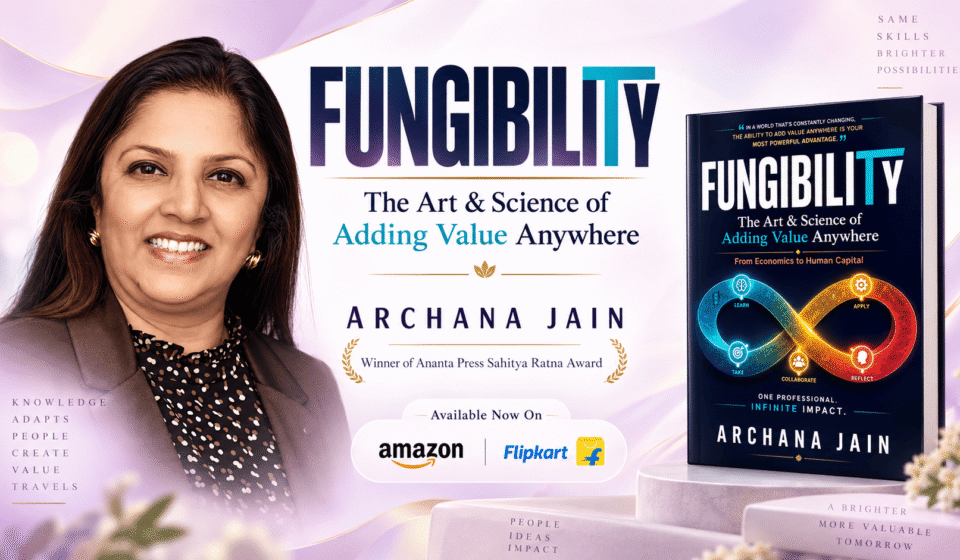

Fungibility: The Art & Science of Adding Value Anywhere can be read as a personal career guide, but its implications reach much further. Archana Jain’s central idea – that people should cultivate capabilities that can travel across roles, functions, industries, and challenges – is equally relevant to leaders designing teams, organizations preparing for disruption, educators preparing students, and professionals trying to build resilient identities. What gives the book unusual breadth is its ability to connect individual self-development with a larger question: what kind of human capability will organizations need when change becomes continuous rather than occasional?
Most organizations still operate with structures created for a more predictable world. Jobs are defined, skills are matched to jobs, people are promoted through functions, and training is often provided after a gap becomes visible. This model works when work changes gradually. It becomes less effective when technology can redefine a process within months. Artificial intelligence, automation, new business models, and changing customer expectations create problems that rarely respect departmental boundaries. In that environment, a workforce made entirely of narrow specialists can become surprisingly fragile. Deep expertise remains essential, but expertise alone is not enough if people cannot transfer what they know into new situations.
Jain’s idea of fungibility provides a useful language for this challenge. In the book’s context, fungibility does not mean that one employee can simply replace another. It means that a professional has developed enough learning agility, adaptability, judgment, collaboration, and transferable skill to remain useful as the context changes. That is a much richer concept than “multi-skilling.” Multi-skilling often implies accumulating tasks. Fungibility is about understanding capabilities deeply enough to redeploy them. A person may not know a new domain on day one, but they can enter it intelligently, learn what matters, connect prior strengths, and begin contributing.
For individuals, this creates career resilience. For organizations, it creates strategic flexibility. Consider the difference between a team that depends on perfect role boundaries and a team where people understand how to contribute across interfaces. The second team is better positioned to handle transformation because employees can move toward emerging needs. They can collaborate across silos, learn unfamiliar systems, and identify where their existing strengths are relevant. Fungibility therefore has implications for workforce planning, talent mobility, leadership development, succession, and organizational culture.
The book’s emphasis on becoming known for capabilities rather than job titles is especially powerful in this context. Organizations often have hidden talent because people are only seen through the lens of their current positions. An employee may be officially assigned to operations but possess strong facilitation skills. A customer service professional may have exceptional pattern recognition and process-improvement instincts. A technical specialist may be unusually effective at translating complexity for nontechnical stakeholders. A project coordinator may have the emotional intelligence needed for change leadership. When organizations define people too narrowly, these capabilities remain underused.
Fungibility encourages a capability-based view of talent. That can change how managers ask questions. Instead of “Has this person done this exact job before?” the question becomes “What evidence do we have that this person can create value in this kind of challenge?” Instead of “Which employee fits this vacancy?” leaders can ask “Which capabilities does this problem require, and where do those capabilities already exist in the organization?” This shift could improve internal mobility while also helping employees see broader futures for themselves.
Archana Jain’s own professional path supports this wider interpretation of the book. Her career spans advertising, public relations, customer service, coaching, team management, business operations, and technology, with an earlier beginning in children’s clothing design. Such variety illustrates how a career can develop through capability accumulation rather than through one straight line. Her work also extends into mentoring, empowerment, inclusion, sustainability, and community development. This breadth reflects the idea that skills such as communication, leadership, learning, empathy, and strategic thinking can create impact in more than one arena.
The human side of the framework is critical. When organizations hear words like “agility” and “flexibility,” they can be tempted to turn them into demands for employees to constantly do more. Fungibility should not be reduced to that. A healthy interpretation requires development, trust, opportunity, and support. People become adaptable when they are allowed to learn, experiment, admit gaps, ask for help, and take on new challenges without being punished for not already knowing everything. Psychological safety is therefore closely related to fungibility. A culture that expects perfect expertise at all times will produce defensiveness, not learning agility.
This is where Jain’s broader human-centered philosophy adds value. Her work emphasizes that technology can transform processes while human qualities continue to shape leadership and connection. A future-ready organization cannot be built only by deploying better tools. It also requires people who can exercise judgment, build trust, understand emotional realities, and communicate during uncertainty. The more technology accelerates change, the more important these integrative human abilities may become. Fungibility places them alongside technical adaptability rather than treating them as optional “soft skills.”
The book is equally relevant to education. Students preparing for the workplace are often asked to choose fields based on current demand. But current demand can shift faster than a degree cycle. A fungibility mindset suggests that education should develop not only domain knowledge but also the ability to learn, collaborate, communicate, solve unfamiliar problems, and transfer concepts across contexts. Students who understand themselves through capabilities may be better prepared to navigate careers that do not yet have clear titles. They may also be less likely to interpret an unexpected career change as failure.
For experienced professionals, the organizational perspective can also create a new way to think about leadership. Seniority does not automatically make a person fungible. In fact, long success in one environment can sometimes make adaptation more difficult. Leaders who want to remain effective need to preserve curiosity, invite challenge, learn emerging tools, and understand adjacent functions. They must be able to lead through questions as well as answers. A leader who can only create value when conditions are familiar is less resilient than one who can orient themselves quickly in new terrain.
The book’s focus on reflection is significant here. Organizations frequently invest in experience but underinvest in helping people extract learning from experience. Employees complete projects, move to new assignments, and accumulate years, but they may not pause to identify what capabilities actually strengthened. Reflection converts events into transferable knowledge. It enables a person to say, “In that project, I learned how to align conflicting stakeholders,” or “That crisis taught me how to prioritize under uncertainty.” Once named, those capabilities can be deliberately reused.
The concept also has an ethical dimension. If future-ready work is framed only as a race to remain employable, it can become exhausting and individualistic. Fungibility is more valuable when connected to contribution. The question is not merely how to protect oneself from disruption, but how to continue creating meaningful impact. This orientation can lead to better leadership because it asks professionals to focus on problems, people, and outcomes rather than on status preservation. It can also encourage generosity: a truly capable person does not need to hoard knowledge to remain valuable because their strength lies in learning and applying, not in guarding a fixed territory.
What makes Fungibility unique is therefore the scale at which its central idea can operate. At the individual level, it supports confidence and career mobility. At the team level, it encourages collaboration across boundaries. At the organizational level, it supports capability-based talent strategies. At the leadership level, it rewards humility and learning. At the societal level, it offers a way to think about human relevance in an age of accelerating technology. Few career concepts travel that far without becoming vague. Fungibility remains concrete because the central test is simple: can you carry your ability to create value into a new context?
The book is also well suited to the self-help and motivational category because it gives readers a constructive alternative to fear. The future of work is often discussed in terms of replacement, redundancy, and obsolescence. Jain does not deny disruption. She changes the response. Do not attach your identity so tightly to yesterday’s tasks that change destroys your confidence. Build a wider foundation. Learn faster. Develop capabilities that compound. Strengthen human judgment. Collaborate. Reflect. Translate your strengths. Become useful in more than one environment.
For organizations, that message may be just as important as it is for individuals. The future-ready company will not be the one that predicts every change correctly. It will be the one with people capable of responding intelligently when predictions fail. Fungibility: The Art & Science of Adding Value Anywhere gives that capacity a name and turns it into a development philosophy. That makes the book timely, practical, and relevant far beyond a single reader’s career.Amazon link: https://www.amazon.in/Fungibility-Science-Adding-Value-Anywhere-ebook/dp/B0HCL37QY5/ref=sr_1_1?crid=P0MZP65RWR8P&dib=eyJ2IjoiMSJ9.VV1teaHHjTpxtBX2RBvlLl74tqW9136U99KQyxpg4RDGjHj071QN20LucGBJIEps.OavO35Ak7j3XXH2IbLtnlXKLJlM8jVhvqECGUfVrE_g&dib_tag=se&keywords=fungibility&qid=1787137886&s=digital-text&sprefix=fungibilit%2Cdigital-text%2C313&sr=1-1