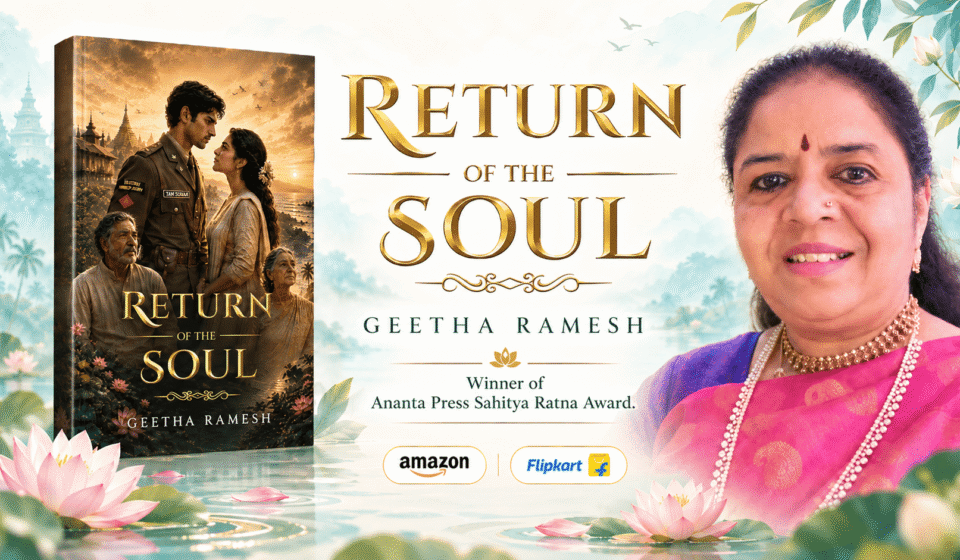

Some romantic novels ask whether two people can remain together despite family opposition, distance or misunderstanding. Return of the Soul by Geetha Ramesh asks a larger question: can love remain alive after death itself, and if two souls meet again, can they recognise what once bound them together? This is the idea that gives the novel its immediate appeal. It combines an emotional love story with wartime history, family drama and reincarnation, creating a reading experience that is both accessible and thought-provoking.
The story begins during the Second World War among an Indian family settled in Burma. This setting gives the novel a strong atmosphere of uncertainty even before the supernatural dimension emerges. War changes the rhythm of ordinary life. Families must think about survival, work and safety, and every relationship exists under the possibility of sudden loss. Roopini, the eldest daughter, is involved in the family business with her father, which gives her a sense of responsibility and maturity.
Then she meets Amudhan, a South Indian soldier who is also a poet. Their relationship introduces warmth into a threatening world. The fact that Amudhan is both soldier and poet makes him an appealing romantic figure because he represents courage as well as sensitivity. Yet the war that brings them together also destroys their chance at an ordinary future. Amudhan dies in Roopini’s lap, leaving her with the promise that he will return to live with her.
This moment is the emotional key to the entire novel. It is tragic, but it is not final. The promise asks the reader to believe, or at least to imagine, that love may have a continuity that the body does not. From this point, the novel moves away from conventional historical romance and into a story about rebirth.
Roopini is later born again as Sreeja, within the same family line, as a daughter of her own sister. Sreeja remembers her previous birth from childhood. This is one of the most engaging aspects of the premise because it places extraordinary knowledge inside an ordinary family setting. The child knows something about herself that does not belong to her present identity. As she grows older, however, she begins to think that these memories may simply be fantasy.
Many readers may find this development relatable even if they do not personally believe in reincarnation. Childhood is full of experiences that feel completely real but are later reinterpreted by adult logic. The novel uses that natural movement from imagination to scepticism to create tension. Sreeja’s memories are not treated as a convenient map guiding her directly to her lost lover. They become something she herself questions.
Her later marriage to another person under family pressure and from a sense of gratitude ensures that the story remains emotionally complicated. If Sreeja had simply waited for Amudhan, the second half might have been predictable. Instead, she makes a major life choice before destiny seems to re-enter. This creates one of the book’s strongest sources of reader interest: what should a person do when an old truth returns after a new life has already been built?
Amudhan is reborn as Sridhar, who remains unmarried and is in his mid-forties when he and Sreeja meet. Eventually, he also remembers the earlier life. The reunion therefore offers the romantic satisfaction of recognition while introducing difficult questions. Their souls may know each other, but their circumstances are no longer those of Roopini and Amudhan. The love is old; the lives are new.
This distinction makes Return of the Soul more mature than a simple fantasy of “soulmates.” The novel recognises that a second chance is never truly a return to the same point. Time changes people. Families shape decisions. Social expectations leave consequences. Even memory itself can become uncertain. The lovers must therefore confront not only what they once meant to each other but what they can mean to each other now.
The book will likely appeal to several kinds of readers. Those who enjoy romance can connect with the enduring bond between the protagonists. Readers interested in historical settings may appreciate the Second World War beginning and the Indian family’s life in Burma. Those drawn to spiritual or metaphysical themes will find the reincarnation element central rather than incidental. And readers who like family drama may respond to the way personal decisions are influenced by duty, gratitude and expectation.
The novel’s emotional strength comes from the contrast between an enormous idea and intimate human moments. Reincarnation is a vast philosophical concept, but the story makes it personal through a dying promise, childhood memory, family pressure and a later meeting between two adults. These concrete emotional situations prevent the theme from becoming abstract. We are not asked only to think about whether rebirth is possible. We are asked what rebirth would do to love.
Geetha Ramesh’s journey as a writer also gives the book an encouraging context. Born in Vellore in 1963, she grew up as the daughter of an army official and travelled widely during childhood. She studied English literature at Ethiraj College in Chennai, but instead of entering writing professionally at that stage, she chose banking. She joined Andhra Bank as a probationary officer in 1985, worked across different places and retired in 2023. After retirement, she returned to the imaginative passion she had carried since childhood.
Her early creativity is particularly charming: she imagined tables, chairs and household furniture as houses, created a town called Poompuhar and invented characters and stories around it. She was also curious about creation itself, wondering how the world came into existence and who made everything. That childhood tendency to build unseen worlds and ask philosophical questions seems very much in harmony with a novel like Return of the Soul, which turns an ordinary human relationship into a meditation on what might exist beyond one visible lifetime.
Ramesh’s post-retirement literary productivity is notable. Her first book, Divine Will, gathered philosophical thoughts and won a non-fiction award from Ukiyoto Publishers. Her second, Niranjana, drew heavily on her banking experiences and has been selected for movie making. Return of the Soul is her third book, a fully imaginary romantic fiction with reincarnation in the background, and it has received an award from Stage Fame International. The range across these books suggests an author comfortable moving between reflection, lived professional experience and imaginative storytelling.
What makes Return of the Soul unique is the combination of scales. It begins with global history, moves into family life, focuses on one love story, expands into reincarnation, and then returns to the practical realities of adulthood. Few romances ask the reader to consider such a long emotional timeline. The relationship is not measured in months or years but across lives.
The title captures that ambition. Return of the Soul refers to rebirth, but it also suggests the return of unfinished feeling. A memory can disappear from conscious thought and still return. A promise can seem impossible and still shape the future. A person can become someone new and yet encounter an old part of themselves. These ideas give the novel a reflective aftertaste beyond the immediate plot.
For readers who enjoy stories of destiny, second chances and enduring bonds, Return of the Soul offers a distinctive premise. For readers who are sceptical of reincarnation, the book can still be enjoyed as imaginative fiction about the persistence of memory and the difficulty of reconciling past desire with present duty. In either reading, the central emotional question remains compelling: if the person you once loved returned in another life, would love alone be enough to overcome everything that happened in between?
That question is the reason the novel lingers. Return of the Soul is not merely about lovers being reborn. It is about what time does to love, what memory does to identity and what responsibility does to destiny. Geetha Ramesh uses a supernatural premise to explore recognisably human emotions, and that combination gives the book its warmth, curiosity and appeal.
Amazon Link