
The wider social value of making preparedness a shared responsibility
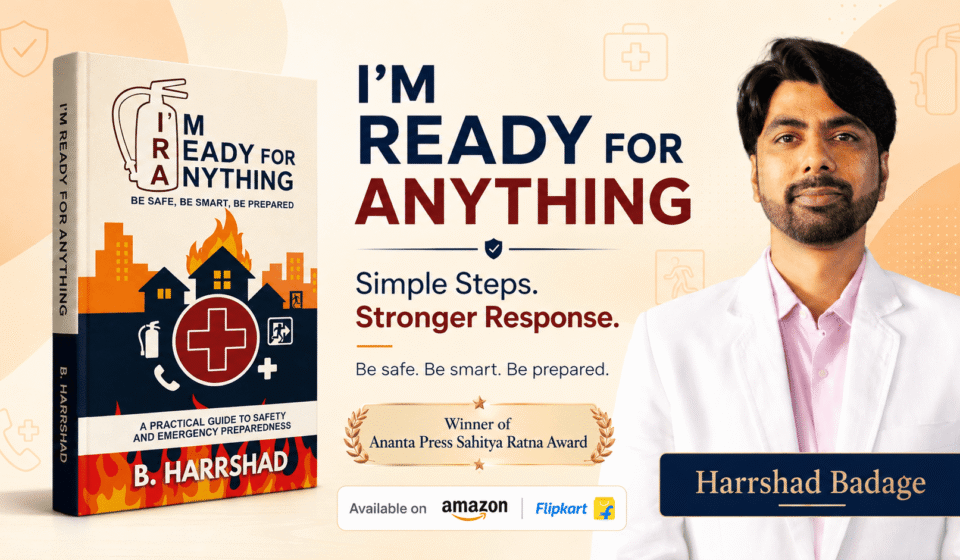
I’m Ready for Anything (IRA) can be read as a personal safety guide, but its larger idea is more ambitious: preparedness should become part of culture. Harrshad Badage’s book does not stop at the individual reader. Its vision extends to families, schools, workplaces, residential communities, and society, suggesting that safety becomes stronger when knowledge is shared rather than isolated. This is what makes the book especially interesting as a work of general nonfiction. It combines the immediate usefulness of an emergency handbook with a broader argument about responsibility, confidence, and community resilience.
The starting point is simple. Emergencies rarely respect personal boundaries. A building fire involves occupants, security staff, neighbors, firefighters, and often nearby residents. A road accident involves the injured person, passengers, bystanders, traffic, police, and medical responders. A flood affects households, infrastructure, transport, utilities, and local communities. A cyber scam may begin with one individual but can affect an entire family financially. Because risk is interconnected, preparedness cannot be purely private. A community in which more people understand basic safety principles is better positioned to respond than one in which everyone assumes that professionals will handle every problem immediately.
IRA’s practical subject matter supports this community perspective. The book addresses fires, floods, earthquakes, road accidents, LPG leaks, blackouts, workplace emergencies, cyber scams, and civil unrest – situations that can affect people across age groups and social settings. It uses relatable stories, Indian case studies, first-aid guidance, checklists, and emergency planning strategies to convert large subjects into manageable actions. The value of these tools increases when they are discussed collectively. A family checklist becomes stronger when every member knows the plan. An evacuation procedure becomes safer when coworkers understand their roles. A school’s preparedness improves when staff and students share basic awareness. A residential society becomes more resilient when neighbors know how to communicate and assist vulnerable residents.
The book’s India-first identity is central to this social usefulness. Badage’s author profile notes that he encountered a recurring gap during years of training: people wanted practical study material after sessions, but much available survival literature focused on snowstorms, wilderness situations, and wildlife encounters. Those subjects were far removed from the concerns Indian participants regularly raised, including LPG leaks, monsoon flooding, road accidents, cyber fraud, building fires, stampedes, and prolonged power failures. IRA was created to respond to that need. By using familiar contexts, it lowers the distance between reading and action.
Localization also matters because resilience depends on the environment in which people actually live. India contains enormous diversity in climate, infrastructure, housing, transport, workplaces, and access to services. A single guide cannot predict every local condition, but it can teach readers to think more deliberately about their own surroundings. Where are the exits? Who in the family needs medication? What happens if mobile networks are overloaded? How does the household communicate during a blackout? What risks are specific to a monsoon season or a crowded public event? The book’s practical approach encourages this kind of situational thinking rather than passive consumption of information.
Another reason the book has social value is its insistence that preparedness is not the same as fear. Fear-driven safety campaigns can attract attention briefly, but they do not always build lasting habits. Badage instead presents preparedness as confidence and care. That framing can make the subject easier to discuss with children, parents, colleagues, and community members. The message becomes: we prepare because people matter, not because disaster is inevitable. This is a much stronger foundation for a safety culture. It connects readiness to responsibility instead of anxiety.
The author’s experience reinforces this emphasis on practical public education. Badage has worked for more than a decade in fire safety, first aid, emergency response, workplace safety, and disaster preparedness, training thousands of participants in industrial, educational, residential, healthcare, and corporate settings. His earlier background in soft-skills training is also relevant because safety culture is fundamentally a communication problem as well as a technical one. Policies and equipment do not create preparedness on their own. People must understand the guidance, believe it matters, remember it, discuss it, and practice it. A book that uses plain language and relatable examples can help bridge that gap.
The often-retold first-aid story from his profile captures the potential ripple effect. During a workshop in Pune, Badage demonstrated an improvised collar bandage made from newspaper and cloth. Years later, a former participant used that remembered technique to stabilize a road-accident victim until professional help arrived. The lesson is broader than first aid. Knowledge can travel. A trainer teaches a participant; the participant later helps a stranger; the stranger benefits from a lesson received years earlier. This is how a culture of preparedness grows – through skills that move from one person to another and become available in moments of need.
The inclusion of cyber scams gives the book’s cultural argument modern relevance. Today’s safety threats are not limited to visible physical hazards. Digital fraud can spread rapidly through families and communities, especially when people are unfamiliar with common manipulation tactics. Safety awareness therefore includes the ability to pause, verify, protect information, and communicate warnings to others. A prepared family does not only know how to respond to smoke or flooding; it also knows how to question suspicious digital urgency. Bringing these issues together helps readers understand preparedness as a broad life competency.
The book may be especially valuable in schools because preparedness is most powerful when learned early. Children and young adults routinely receive academic instruction but may receive little systematic guidance on what to do during a fire, how to respond to an accident, how to recognize a scam, or how to communicate during a disruption. IRA’s accessible style and practical orientation make its ideas suitable for discussion beyond the individual reader. Similarly, workplaces can use the book to complement formal safety programs by making employees more personally engaged with the purpose behind procedures.
For households, the benefit is equally clear. Emergencies become more difficult when one family member is expected to remember everything. Shared plans distribute knowledge. Children can know whom to call. Adults can know where documents, medicines, and supplies are kept. Elderly relatives can understand the communication plan. Neighbors can know who may need extra help. None of these steps guarantee safety, but they reduce avoidable confusion. The book’s emphasis on checklists and planning makes this kind of shared preparation easier to begin.
What distinguishes I’m Ready for Anything from many conventional survival guides is therefore its sense of social scale. It begins with the individual but points outward. The goal is not heroic self-sufficiency. It is collective capability. Readers are encouraged to protect themselves, but also to become people who can make safer choices for others. This is a more humane and realistic understanding of resilience, especially in densely populated settings where emergencies inevitably involve communities.
The book’s tone also deserves recognition. A guide covering fires, accidents, disasters, fraud, and unrest could easily become grim. Yet the material is framed around readiness, not doom. This makes the book easier to recommend to a broad audience. It is serious without being sensational. It acknowledges vulnerability while emphasizing agency. That balance is essential if safety is to become a normal conversation rather than something people discuss only after tragedy.
Ultimately, IRA’s uniqueness lies in the culture it wants to create: a culture in which preparedness is ordinary, practical, shared, and compassionate. Its India-first examples give the book relevance; its checklists and step-by-step methods give it utility; the author’s training experience gives it credibility; and its confidence-based philosophy gives it a constructive emotional core. More than a manual for surviving emergencies, it is an invitation to become the kind of person – and the kind of community – that is better prepared before help is urgently needed.
For readers, families, educators, managers, and community leaders, that makes I’m Ready for Anything a valuable resource. Its message can be summarized in a simple progression: learn, prepare, practice, share. When safety knowledge becomes part of everyday life, people do not merely become more ready for emergencies; they become more capable of caring for one another. That is a meaningful contribution, and it gives the book lasting relevance beyond the moment in which it is read.
Amazon Purchase Link: https://amzn.in/d/01LeypC9