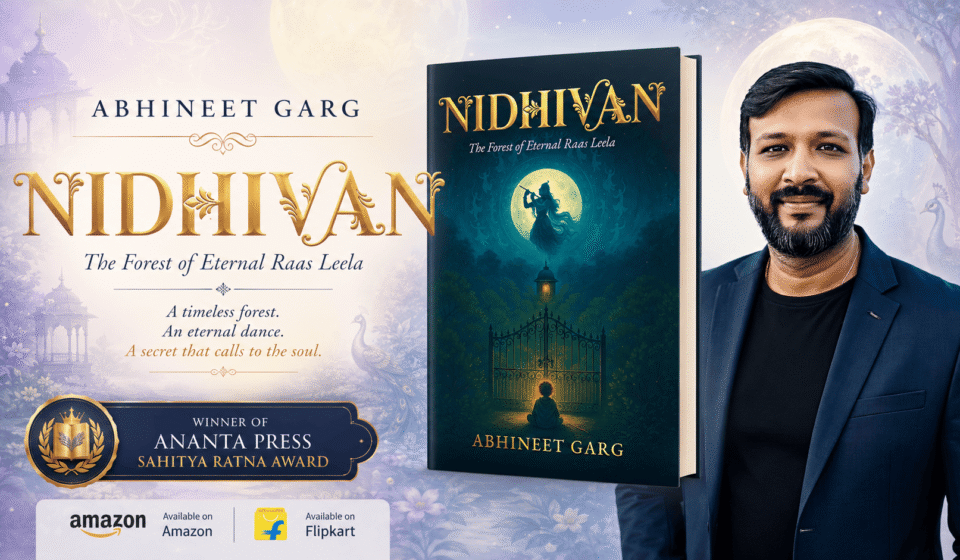

Nidhivan: The Forest of Eternal Raas Leela has the kind of premise that immediately creates images in the reader’s mind. A sacred grove in Vrindavan is emptied before sunset. Gates are secured. Rang Mahal is prepared. Offerings are left for an unseen presence. The night belongs to a mystery that devotees do not treat as metaphor. Somewhere beyond the locked boundary, it is believed that Radha and Krishna continue their eternal Raas Leela. Anyone who attempts to remain behind risks witnessing something the human mind may not be prepared to hold.
Abhineet Garg turns this charged premise into a spiritual mystery thriller with a strongly cinematic pulse. The novel is not simply designed to frighten. It is designed to immerse. Its suspense grows through place, ritual, silence, memory, and the gradual loss of certainty. The reader is led into Nidhivan through three different characters across three timelines, and each journey changes the emotional meaning of the forest.
The first storyline follows Anirudh Narayan in 1985. He is an NRI journalist who arrives with the confidence of a professional investigator. Legends, to him, are stories waiting to be exposed, explained, or published. This makes him an engaging point of entry for readers who may share his skepticism. He asks the practical questions. Who locks Rang Mahal? Who touches the offerings? Why do people accept the prohibition against remaining in the grove? Can fear and tradition create the illusion of a supernatural event?
The strength of his storyline lies in the pace of his transformation. The novel does not need to make him believe instantly. Instead, curiosity becomes irritation, irritation becomes determination, and determination becomes obsession. The more the mystery resists him, the more personally he takes that resistance. His investigation turns into a contest between his need for an answer and the forest’s refusal to provide one on his terms. This is classic thriller material, but Garg gives it spiritual weight. Anirudh’s real adversary may be his own certainty.
The second seeker, Radha, enters in 1988. Her chapter of the mystery has a softer but more emotionally dangerous tone. She is not trying to expose a legend for professional success. She is drawn by longing, faith, and the need for meaning. This shift allows the novel to move beyond the familiar believer-versus-skeptic debate. Radha believes, yet belief does not protect her from the consequences of forbidden curiosity.
Her journey is likely to be especially affecting for readers because it reveals how devotion can become intensely personal. To love the divine is to desire closeness, but what happens when that desire becomes a demand to see? What happens when a person believes that one extraordinary experience will heal grief, confirm faith, or answer every unanswered question? Radha’s storyline gives the supernatural mystery an emotional centre. The forest becomes not only frightening but seductive.
Meera, the historian who arrives in 1990, brings the broadest lens. Her investigation connects the mystery to the sacred geography and living traditions of Vrindavan. Through her research, the reader encounters Rang Mahal, Lalita Kund, Gopeshwar Bhagwan, Swami Haridas’s legacy, Radha temples, and the Ashta Sakhi tradition. These elements enrich the story without slowing its momentum because they create a sense that every location and ritual may contain part of a larger pattern.
Meera’s approach also gives the book credibility. She does not dismiss testimony, but she does not accept every claim without examination. She understands that oral tradition, history, ritual, and faith preserve different kinds of truth. Her balanced method brings her closer to the mystery than either arrogance or emotional urgency. Yet the novel’s central rule remains intact: closeness to truth does not automatically grant the right to possess it.
The three timelines generate a satisfying rhythm of revelation. Details echo across the years. An object, ritual, phrase, or warning may first appear unexplained, then acquire a different meaning in another storyline. The reader becomes an investigator, comparing what Anirudh recorded, what Radha felt, and what Meera understood. This layered design encourages active reading and creates the pleasure of connecting fragments.
The present-day narrator strengthens that experience. As a five-year-old boy, he receives Meera’s final account. At forty, he begins collating the remains of three incomplete investigations. This framing device gives the book a found-document quality without trapping it inside a rigid documentary format. Notes, memories, testimonies, and inherited fear can all become part of the narrative texture.
More importantly, the narrator gives the mystery a human afterlife. The events did not end in 1990. They continued inside the child who heard too much and understood too little. His adult attempt to reconstruct the past is therefore both investigative and personal. He is seeking the truth about Nidhivan, but he is also seeking the missing foundation of his own life.
From a visual perspective, the novel appears naturally suited to screen adaptation. Its major locations carry strong symbolic imagery. Rang Mahal can be shown in preparation before the final lock is placed. The grove can shift from devotional beauty in daylight to unreadable depth at night. The twisted trees, moonlight, lamps, temple bells, whispered warnings, old documents, and recurring sacred motifs can create a distinctive visual identity. The three periods allow changes in costume, technology, colour palette, and pace, while the present-day frame provides a clean narrative spine.
Yet cinematic quality is not only a matter of scenery. Garg’s concept is cinematic because it is built around escalation. Each seeker enters with a different emotional objective. Each follows clues. Each crosses an internal or external boundary. Each leaves behind an incomplete account. The audience gradually understands that the stories are not separate cases but parts of one design. This architecture naturally produces suspense and anticipation.
The book also makes a refreshing choice in its approach to horror. There are no generic creatures required to make Nidhivan frightening. The terror comes from rules that people obey without public proof, offerings touched by an unseen guest, and the possibility that the legends are literally true. The reader’s imagination does the work. What might a person hear from beyond the locked gate? What would happen if someone witnessed the Raas Leela? Would the danger be physical, psychological, spiritual, or all three?
This restraint makes the story more haunting. Spectacle often becomes ordinary once it is described in detail. Nidhivan’s power depends on partial revelation. The unknown remains active because it is never reduced to a visual effect. Even when the narrative approaches the truth, it preserves the sense that some realities exceed language.
The emotional and philosophical themes give the thriller lasting value. Anirudh represents ego and rational control. Radha represents longing and devotion. Meera represents knowledge shaped by humility. The narrator represents inheritance and memory. Together, they create a journey from the desire to conquer mystery toward the possibility of surrendering before it.
Readers who come for suspense will find forbidden spaces, linked timelines, unexplained evidence, disappearances, warnings, and an approaching climax. Readers who come for mythology will find a story rooted in Radha-Krishna devotion and the sacred traditions of Vrindavan. Readers who come for emotional depth will find characters driven by ambition, longing, grief, responsibility, and unresolved memory. This combination gives the novel cross-genre appeal.
The author’s broader creative interests also support the book’s tone. Abhineet Garg writes across psychological thrillers, mythology, spiritual fiction, romance, and emotionally driven drama. That range is visible in the premise of Nidhivan. It needs the mind of a thriller writer to manage clues, the sensitivity of an emotional storyteller to portray longing, and the restraint of a spiritual novelist to avoid trivializing sacred material.
A major reason the book stands out is that its central mystery is culturally grounded. The legend of Nidhivan already carries centuries of faith and contemporary fascination. Garg does not need to invent a mythology from nothing. His creative achievement lies in shaping that living belief into a layered narrative while preserving its dignity. The story invites curiosity, but it repeatedly warns against entitlement.
By the end, the reader is left with more than the question of what happens inside Nidhivan after sunset. The deeper question is what a human being hopes to gain by witnessing the divine. Proof? Fame? Healing? Certainty? Transformation? The answers differ for each seeker, and those differences determine the emotional meaning of their journeys.
Nidhivan: The Forest of Eternal Raas Leela is an atmospheric, visually rich, and spiritually resonant thriller. It respects the unknown instead of treating it as a puzzle box. It understands that mystery becomes memorable when it touches character, culture, and belief at the same time. Most of all, it leaves the reader with an image that is difficult to forget: a locked gate, a silent forest, and the possibility that beyond human sight, the eternal dance has never ended.
PURCHASE THE BOOK