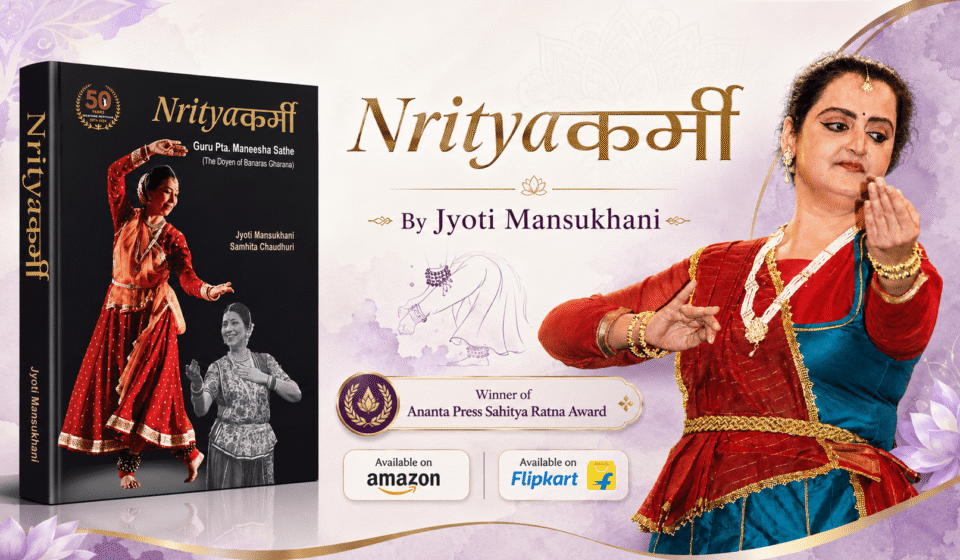

Nrityaकर्मी carries the warmth of a tribute, the organisation of a cultural project and the seriousness of an artistic document. Its subject is Guru Pta. Maneesha Sathe ji, whose journey in Kathak spans more than six decades. Its principal author, Jyoti Mansukhani, is herself a dancer, teacher, organiser and cultural worker. This relationship between subject and author is one of the book’s defining strengths. The biography is written not from a distant academic position, but from within the world whose values it seeks to preserve.
Writing from within an artistic community brings advantages as well as responsibilities. An insider understands terminology, etiquette, lineage and the significance of details that an outside observer may overlook. At the same time, affection can sometimes make a tribute overly reverential. Nrityaकर्मी appears to address this challenge through its broad structure and many contributors. Jyoti’s voice initiates the project, but the portrait is expanded by photographs, videos, senior Gurus, artistes, musicians, technicians and students from different decades. The result is a collective testimony rather than a single admirer’s account.
The first section gives readers the essential biographical arc. Maneesha ji’s childhood, training and development are followed across the roles of performer, teacher, Guru and legend. These are not merely career stages. Each represents a transformation in how an artiste relates to knowledge. The student receives. The performer interprets. The teacher explains. The Guru guides lives and protects standards. The legend becomes a reference point for an entire community. By structuring the journey in this way, the book helps readers understand the widening influence of a dedicated practitioner.
The photographs animate this progression. Images of childhood and family create emotional proximity. Photographs of parents and Gurus reveal origins and lineage. Solo performances convey command and individuality. Images with students show the growth of a pedagogical legacy. Because these materials range from early years to the present, they make time visible. Readers do not simply learn that six decades passed; they witness a life unfolding across them.
The videos of selected performances are particularly well suited to Jyoti’s purpose. She has watched many of Maneesha ji’s performances live and attended workshops where she observed her work closely. Her inspiration for the book emerged partly from watching and listening, from noticing intensity that deserved to be recorded. By including video, she gives readers access to the same kind of direct encounter that first moved her. The book therefore does not ask readers to accept praise without evidence; it allows the art to speak.
The second section demonstrates Jyoti’s skill as a convener. Bringing together thirty-two meaningful contributions from senior figures and close associates requires trust, persistence and editorial judgement. Contributors such as Taalyogi Pt. Suresh Talwalkar ji, Pt. Rajendra Gangani ji, Pt. Jai Kishan Maharaj ji, Shama Bhate ji, Dr. Sucheta Chapekar ji and Pt. Nandkishore Kapote ji represent significant experience within Indian classical arts. Their participation transforms the book into a meeting place of memories.
The inclusion of musicians and technicians alongside Gurus and dancers is admirable. It acknowledges that performance is collaborative. A dancer’s excellence may be most visible, but it is shaped and supported by rhythm, music, lighting, sound, stage preparation and countless acts of coordination. People in these roles often observe the performer in moments of concentration and challenge that audiences never see. Their accounts can therefore reveal professionalism and character in distinctive ways.
The unique tagline assigned to each write-up suggests that the editors have approached the material creatively. A compilation can feel repetitive when every contributor offers similar praise. Taglines help establish difference and invite each anecdote to carry its own meaning. This is essential to the book’s stated goal of presenting Maneesha ji not only as an artiste but as a sensitive human being. Humanity is revealed through variation – one person remembers encouragement, another rigour, another humour, another artistic daring.
The third section brings the narrative to the place where a Guru’s influence is most enduring: the students. Senior students representing every decade speak as pillars of Maneesha Nrityalaya. Their inclusion converts the book from a record of achievement into a record of transmission. Readers can see how one person’s discipline becomes many people’s discipline, how one artistic vision produces multiple individual journeys and how a teaching institution becomes a living family.
This section is also likely to inspire younger dancers. The path of classical training can be demanding, and students may sometimes see correction only as pressure. Looking back, senior disciples can explain how strictness, patience, repetition and faith contributed to their development. Their reflections may help new learners understand that progress is rarely immediate and that a Guru’s impact often becomes fully visible only with time.
Jyoti’s own biography adds depth to the project. She is a Physics graduate from the University of Mumbai and holds a Master’s degree in Indology from Tilak Maharashtra Vidyapeeth. This combination of analytical education and cultural study may have assisted her in organising a large body of material. She also worked in major companies before dedicating herself more extensively to dance and cultural initiatives. Her path demonstrates an ability to move between professional organisation and artistic sensitivity.
As a Kathak dancer, she trained under several eminent Gurus and continues training under Smt. Tejaswini Sathe. Her additional learning in vocals and Djembe suggests curiosity about rhythm and musicality beyond a single form. This matters because a biography of a dancer benefits from an author who understands that performance is created through multiple sensory and disciplinary relationships.
Her work through Prerana Foundation reveals the larger purpose behind her cultural activity. For more than twenty years, she has organised dance competitions in Indian classical and folk forms. She helped institute the Late Pt. Lachchu Maharaj Award for Kathak and the Late Acharya Parvati Kumar Award for Bharatanatyam, and later launched Ekal Nritya Utsav to provide solo winners with a platform for thematic performance. These initiatives show that she does not merely admire excellence; she builds structures through which others can grow.
Her 2009 DVD, My Journey with Kathak Maestros, is particularly relevant to Nrityaकर्मी. Guided by Maneesha ji, that project documented distinguished Kathak maestros in Maharashtra and was launched in the presence of major Gurus. It established a precedent for combining research, community participation and visual media. Nrityaकर्मी can be seen as a more focused and expansive continuation of the same mission: to preserve artistic lives before their knowledge becomes inaccessible.
The scale of Jyoti’s vision is evident in Nrityachakra, the historic 2024 event that brought together 1,188 Kathak dancers from twenty cities across Maharashtra. Performing continuously for twenty minutes and twenty-five seconds on three compositions, the ensemble achieved recognition in record books. The event required planning, persuasion, coordination and a belief that individual dancers could become part of a shared cultural statement. The same qualities are visible in a book that gathers dozens of voices around one legacy.
Jyoti’s resilience gives her commitment added meaning. Living for decades with Lupus and serious medical complications, she continued to teach, choreograph and organise. Her life demonstrates that artistic service need not depend on perfect circumstances. This makes her tribute to Maneesha ji especially moving. She recognises devotion not as a romantic idea but as a daily decision sustained through limitation, responsibility and uncertainty.
The bond between Jyoti and Maneesha ji is described as one based on love, care and mutual respect. Maneesha ji’s encouragement made Jyoti feel valued even when health challenges prevented her from pursuing Kathak as a full-time career. That emotional history helps explain why the book exists. It is an act of gratitude, but not a private one. Jyoti turns gratitude into public documentation so that readers, students and future researchers can benefit.
This transformation of personal affection into cultural service is perhaps the book’s most beautiful quality. Many people admire their teachers, but few undertake the demanding work of collecting photographs, securing contributions, organising decades of history and designing a meaningful narrative. Nrityaकर्मी represents that labour of love. Its sincerity comes not merely from emotional language but from the scale of the effort involved.
The book will be especially valuable to dancers, teachers and institutions, yet it also has broad appeal. It tells readers that a purposeful life is made from sustained action. It shows how one person can influence an entire network without losing sensitivity. It demonstrates how a student or admirer can honour a Guru by preserving not only achievements but stories, relationships and values.
As non-fiction narrative, Nrityaकर्मी stands out for combining personal closeness with collective evidence. It is intimate without being narrow, celebratory without being empty, and visually rich without reducing the story to images. It honours Guru Pta. Maneesha Sathe ji, but it also honours the culture of learning, collaboration and transmission that made her journey possible.
Ultimately, the book is about continuity. Maneesha ji received an artistic inheritance, expanded it through performance and teaching, and passed it to generations of students. Jyoti received encouragement and inspiration, then converted those gifts into documentation and cultural action. Readers now receive the resulting record. In this way, Nrityaकर्मी itself becomes part of the Guru-Shishya chain – a carefully prepared offering that carries memory forward.