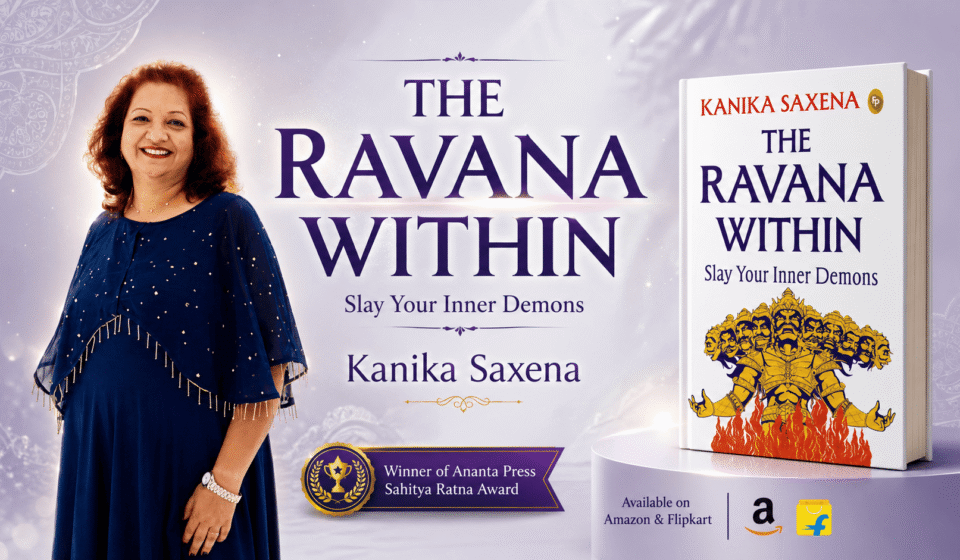

Some self-help books are best understood not only through their subject but also through the life of the person who wrote them. The Ravana Within: Slay Your Inner Demons gains special meaning when placed beside Kanika Saxena’s journey of reinvention. Her career began in engineering and moved through teaching, industry, consultancy, and marketing. She then stepped away from professional life to raise her children, lived abroad, returned to India after thirteen years, faced uncertainty about restarting, struggled with limited computer skills, encountered rejection, and eventually built a new identity as a content writer, team leader, freelancer, technology writer, life coach, speaker, YouTube creator, and author. The book’s message—that the greatest limitations are often the ones operating within us—therefore feels connected to lived experience rather than theory alone.
The inner demons identified in the book are not unusual or sensational. They are precisely the traits that quietly shape ordinary lives: ego, anger, greed, jealousy, procrastination, self-doubt, and attachment. Their familiarity is what makes them dangerous. People learn to justify them. Ego becomes “self-respect.” Anger becomes “honesty.” Greed becomes “ambition.” Jealousy becomes “fair comparison.” Procrastination becomes “waiting for clarity.” Self-doubt becomes “being realistic.” Attachment becomes “love.” The Ravana Within asks readers to look beyond these convenient labels and examine whether a thought or habit is expanding life or restricting it.
The metaphor of Ravana is particularly effective for a book about hidden potential. Ravana is remembered as powerful, knowledgeable, and capable. His downfall did not come from a lack of gifts but from the failure to govern desire, pride, and judgment. This distinction has enormous motivational value. Many readers do not need to become more talented before they improve their lives. They need to stop allowing fear, delay, resentment, or ego to misuse the talent they already possess. A capable person can remain stuck for years if self-doubt prevents action. A loving person can damage relationships if attachment becomes control. An ambitious person can lose peace if greed makes every achievement feel insufficient.
Kanika Saxena’s own return to work demonstrates how an inner demon can be challenged through small action. She did not know how to use a computer confidently, so she began practising typing on an old laptop. She did not have a clear destination, but she created movement. This detail captures an essential principle of personal growth: clarity often follows action rather than preceding it. Procrastination tells us to wait until the full path is visible. Courage begins with the next available step.
Her encounter with the content-writing advertisement also shows how opportunity can appear in an unfamiliar form. A conventional view of career continuity might have treated the long break as an ending. Instead, communication skills became the bridge to a new profession. Rejections based on age or limited technical ability could have confirmed self-doubt, yet persistence eventually led to selection at an IT startup. Entering a workplace where colleagues were much younger could have intensified insecurity, but she learned with their support and excelled in the work itself. Promotion to team leader within six months and recognition for her team demonstrate what can happen when a person stops demanding perfect readiness and begins using existing strengths.
This background makes The Ravana Within especially relevant to readers who believe they have missed their moment. Reinvention is not restricted to youth, and personal growth is not a straight line. Careers pause. Families relocate. plans collapse. Technology changes. Health crises or global events disrupt certainty. The inner Ravana uses these facts to create permanent conclusions: “It is too late,” “I am no longer capable,” “Others are ahead,” or “I cannot begin until conditions improve.” A book that teaches readers to identify self-doubt, attachment, and procrastination can help separate circumstance from surrender.
The COVID-19 period appears to have been another turning point in Saxena’s journey. Losing clients and becoming consumed by anxious news could have led to prolonged helplessness. Instead, reducing exposure to distressing coverage created mental space, and that space led toward personal growth, a book-writing workshop, and her first self-published book. This sequence reflects the book’s larger philosophy. We may not control a crisis, but we can examine what we repeatedly allow into the mind, how we respond to uncertainty, and what constructive action remains possible.
The Ravana Within builds on the author’s continued engagement with self-help writing and life coaching. That experience matters because motivational advice becomes more useful when it respects the complexity of change. Readers do not simply need encouragement to “believe in themselves.” They need tools to recognise the beliefs, impulses, and emotional patterns that repeatedly undermine belief. The book’s practical insights, relatable examples, and self-reflection exercises are designed to create this deeper engagement.
One of the most valuable ideas in the book is that self-conquest is not a single event. An epic battle has a visible conclusion, but inner work continues through daily decisions. Ego may be managed in one conversation and reappear in the next. A person may overcome procrastination on one project and avoid another. Attachment may loosen gradually. Self-doubt may return during every new level of growth. This does not mean the reader has failed. It means self-awareness must become a practice.
The structure around multiple inner demons supports this ongoing practice. A reader can identify the trait that is most active at a particular stage of life. For someone seeking career change, self-doubt and procrastination may be central. For a person navigating conflict, ego and anger may require attention. For someone exhausted by comparison, jealousy and greed may be more relevant. For a reader facing loss or transition, attachment may be the deepest challenge. The book’s framework is flexible enough to meet readers in different situations.
Its tone, as suggested by its premise, is likely to be motivational without being escapist. The goal is greater peace, confidence, and personal growth, but the route passes through honest responsibility. That is important because confidence built on denial is fragile. Lasting confidence develops when a person sees weaknesses clearly and knows they can still choose wisely. Peace is not created by controlling every circumstance; it is strengthened by reducing the power of compulsive reactions. Growth is not proved by public praise; it is proved by the increasing alignment between values and behaviour.
The book also carries a strong message for women who have taken career breaks or placed family responsibilities at the centre of life for many years. Social narratives often treat such periods as professional disappearance. Saxena’s story challenges that assumption. Skills can be renewed, identities can expand, and new work can emerge from experiences that once seemed unrelated. The ability to teach children, manage a household, adapt across countries, communicate, learn, and persevere can become part of a later professional strength. The inner demon may say that the past has made the future impossible; reinvention proves otherwise.
What ultimately makes The Ravana Within unique is the way it joins an epic symbol, practical self-reflection, and the credibility of a life repeatedly rebuilt. It speaks to the universal desire to become better while acknowledging why becoming better is difficult. Our greatest obstacle is often not lack of information. Most people already know that anger can harm, ego can blind, greed can exhaust, jealousy can poison, delay can cost opportunities, doubt can shrink dreams, and attachment can create suffering. The challenge is noticing these forces at the moment they take control.
This book invites that moment of recognition. It asks the reader to stop viewing personal limitations as fixed identity and begin treating them as patterns that can be understood and changed. It is a suitable read for anyone seeking courage, clarity, or a disciplined new beginning. The message is both demanding and compassionate: there is a Ravana within, but there is also the awareness capable of defeating him. Our history influences us, our circumstances test us, and our fears speak loudly, but none of them must be given the final word.
Buy the book on Amazon: https://amzn.in/d/0cVDtzND