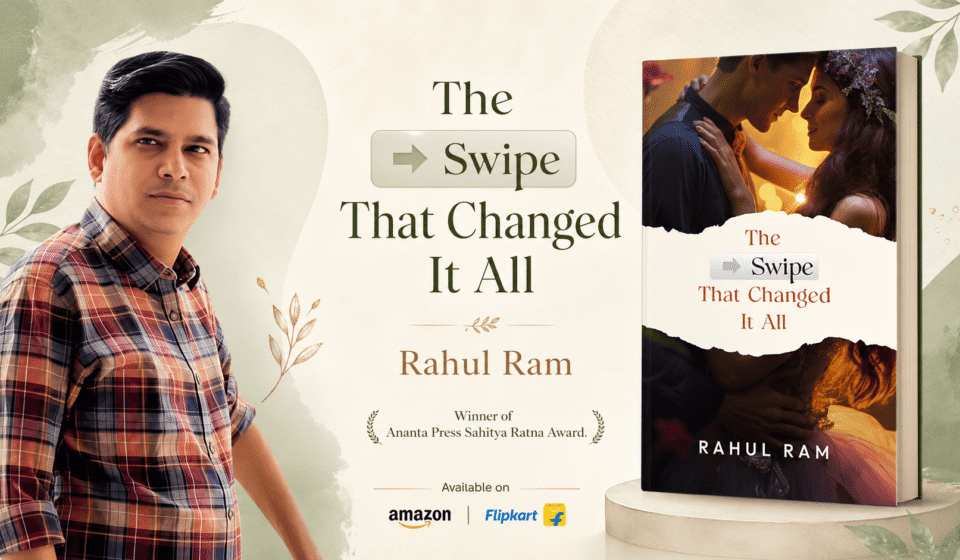

The Swipe That Changed It All by Rahul Ram
The Swipe That Changed It All is a book for readers who have ever wished they could turn off a painful memory. That wish may come after a loss, a broken relationship, a regret, or a moment that permanently changes the way life feels. Rahul Ram takes this private human desire and transforms it into the foundation of a compelling work of fiction. His protagonist, Vivaan, does not merely imagine freedom from pain. As an inventive genius, he tries to create it.
Vivaan’s machine is designed to remove the sensation of pain so that he can escape the constant memories of losing his loved ones. The idea is immediately dramatic, but it is also emotionally recognisable. Pain can become exhausting. It can repeat itself through memory long after the original event has passed. It can make ordinary moments feel heavy and can cause people to withdraw from those who still care for them. Vivaan’s invention is extraordinary, yet the need behind it is deeply human.
The novel becomes especially moving because Vivaan’s search for relief leads him away from Aanya, his passionate love. In trying to protect himself from the pain of the past, he loses something precious in the present. This conflict gives the story its emotional urgency. Readers are not simply asked whether the machine will work. They are asked whether success would be worth the cost.
That is one of the book’s strongest qualities. It creates suspense through emotion rather than relying only on external danger. The central threat is the possibility that Vivaan may become free from pain but unable to experience love in the same way. His invention may solve one problem while creating a larger one. The reader is encouraged to think about how joy, grief, memory, and attachment are connected.
Many stories describe healing as a return to happiness. The Swipe That Changed It All presents a more thoughtful idea. Healing is not necessarily the removal of every difficult feeling. It may be the ability to continue living without allowing pain to control every decision. It may involve accepting that memories can hurt and still be valuable. It may require letting another person come close even when closeness creates risk.
Aanya represents this possibility. She is connected to Vivaan’s sense of meaning, but she is not merely a symbol waiting to reward him. Her relationship with him has been affected by his choices. The theme of second chances therefore carries emotional weight. A second chance between them would require more than renewed attraction. It would require Vivaan to become present, responsible, and willing to face the feelings he has tried to remove.
This message makes the novel relevant to readers beyond the romance genre. Anyone who has used work, distraction, ambition, or emotional distance to avoid grief may recognise part of Vivaan’s struggle. Most people do not build machines, but many build routines and walls. The story uses speculative technology to show how avoidance can become a way of life.
The modern digital setting also strengthens the theme. The title refers to a swipe, a gesture that has become ordinary in an age of smartphones and online platforms. A swipe can produce immediate change. It can open a new image, reject a profile, answer a message, or move attention elsewhere. The ease of the action can create the illusion that emotional life should be equally simple. Yet the novel reminds readers that relationships cannot be repaired with a single gesture. Grief cannot be deleted like unwanted content. Love cannot be preserved through an automatic setting.
Rahul Ram brings a credible understanding of technology to this story. He studied software engineering and has spent more than twelve years working in digital marketing. His professional experience has allowed him to observe how technology shapes behaviour, attention, communication, and choice. This background helps explain why his debut novel places a technological invention inside a relationship drama. He understands both the attraction of digital solutions and the emotional needs they cannot fully satisfy.
The author’s journey also adds sincerity to the work. Born in Pollachi and based in Coimbatore, Rahul Ram grew up enjoying books and movies. His desire to publish developed gradually through years of reading and professional life. He was inspired by contemporary Indian authors known for accessible stories of love and relationships, while also reading writers associated with mythology and mystery. These influences support a novel that aims to be readable, emotionally engaging, and driven by a memorable concept.
The book’s appeal lies in this accessibility. Its themes are substantial, but the central conflict can be understood immediately. Vivaan is suffering. He believes technology can save him. His obsession costs him Aanya. The possibility of healing depends on whether he can recognise that a life without pain may also become a life without emotional depth. This clarity makes the novel suitable for readers who want an engaging story that also leaves them with questions.
One of those questions concerns the meaning of memory. Memories are not neutral records. They carry sensations, relationships, and identity. A painful memory may also contain evidence of love. To remove its emotional force completely could change the way a person understands the past. Vivaan’s project therefore risks altering more than discomfort. It risks changing his relationship with the people he lost and with the person who still loves him.
Another question concerns empathy. People often become compassionate because they know what pain feels like. Suffering does not automatically make someone kinder, but the ability to feel creates the possibility of recognising another person’s hurt. A world without pain might appear peaceful, yet it could also become emotionally distant. Through Vivaan’s personal crisis, the novel invites readers to think about the social value of emotional sensitivity.
The story also speaks to the pressure to appear strong. Vivaan is brilliant and inventive, qualities often associated with control. Grief challenges that identity because it cannot be solved through intelligence alone. His machine may be understood as an attempt to preserve the image of strength. Yet the novel suggests that genuine strength may be found in admitting vulnerability, asking for connection, and accepting that some experiences must be felt before they can be integrated.
Aanya’s love is important in this process because love offers presence rather than erasure. She cannot remove Vivaan’s memories, but she can represent a future that is not defined only by loss. This is why the relationship has emotional importance beyond romance. It becomes a choice between remaining trapped in the effort to escape and allowing life to become meaningful again.
The second-chance theme gives the novel hope without making the conflict easy. Readers who enjoy redemptive stories may find this especially satisfying. Redemption is meaningful when a character understands what has been lost and why. Vivaan’s journey asks him to recognise that his attempt to defeat pain has caused pain. The possibility of change begins with that recognition.
The Swipe That Changed It All is unique because it brings together emotional realism and speculative imagination. It does not require readers to choose between romance and technology. Instead, it shows how technology can become part of a romantic conflict when it changes the way a person relates to feeling. The machine is not simply futuristic equipment. It is a mirror of Vivaan’s fear.
For readers, the novel offers several reasons to engage. It has a strong and easy-to-understand premise. It addresses universal experiences of love, loss, and regret. It reflects modern concerns about the growing role of technology in private life. It promises emotional tension through the relationship between Vivaan and Aanya. It also carries a hopeful message that people can confront damage, learn from it, and seek another chance.
As a work of general fiction, the book can appeal to a broad audience. Romance readers may connect with the endangered love story. Readers interested in science and technology may enjoy the central invention. Those drawn to emotional and motivational narratives may appreciate the focus on healing and resilience. The story is especially suitable for anyone who prefers fiction that entertains while raising meaningful questions.
Rahul Ram’s debut reflects the perspective of a modern storyteller who understands digital systems but remains deeply interested in human emotion. His professional and creative worlds meet in a story that asks where technology should stop and emotional courage should begin. This combination gives the novel its identity.
The final impression of The Swipe That Changed It All is one of thoughtful hope. Pain can make people hide, but it can also reveal what matters. Love can be damaged, but damage does not always mean the end. Technology can offer extraordinary tools, but it cannot replace honesty, empathy, or the decision to remain emotionally alive. Vivaan’s most important invention may not be the machine he builds. It may be the new way of living he discovers when he finally understands that feeling is not a weakness.
This is why the book deserves to be read. It turns a futuristic idea into a personal question that almost everyone can understand: if you could erase your pain, what else might disappear with it? Rahul Ram’s answer is not to glorify suffering, but to defend the full range of human experience. The Swipe That Changed It All suggests that healing begins not when every wound is forgotten, but when a person finds the courage to feel, love, and move forward again.
Buy the Book on Amazon: https://www.amazon.in/Swipe-That-Changed-All/dp/B0DWXFBFZJ/