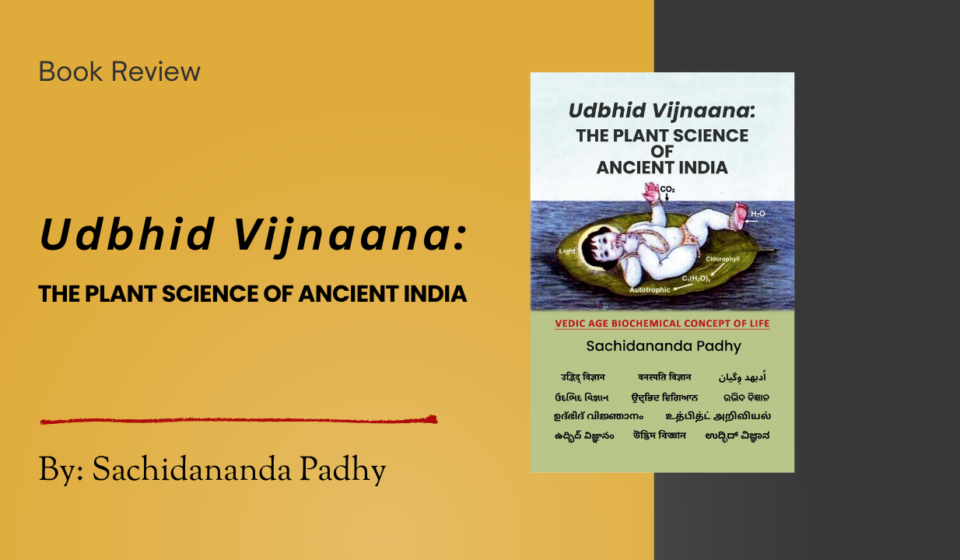

The history of science is often narrated through modern discoveries and contemporary research, leaving many ancient knowledge traditions overlooked. Udbhid Vijnaana: The Plant Science of Ancient India (Aspects of Ethnobotanical Investigation) by Sachidananda Padhy challenges this conventional perspective by taking readers deep into India’s botanical heritage. It is an ambitious work that combines history, Sanskrit literature, ethnobotany, ecology, and scientific inquiry into a single comprehensive narrative. More importantly, it demonstrates that the relationship between humans and plants has always been far richer than merely identifying species or documenting medicinal uses.
Unlike many books that focus exclusively on modern botanical principles, Udbhid Vijnaana explores how ancient Indian scholars understood the plant kingdom through observation, experience, and systematic classification. The author argues that many concepts associated with modern plant science had conceptual foundations in ancient Indian texts, inviting readers to reconsider the scientific value embedded within traditional literature.
One of the book’s defining strengths is its interdisciplinary nature. Rather than limiting itself to botany, it draws meaningful connections between agriculture, medicine, philosophy, religion, architecture, linguistics, and environmental ethics. This holistic approach reflects how ancient Indian civilization viewed nature—not as isolated scientific subjects but as interconnected elements of life itself.
The author’s extensive research is evident throughout the book. References to classical Sanskrit literature, historical manuscripts, ancient scholars, and ethnobotanical practices reveal years of dedicated study. Yet the book never feels like a mere compilation of references. Instead, it attempts to weave these diverse sources into a coherent narrative that explains the evolution of botanical thought across centuries.
Among the most engaging sections are those devoted to the contributions of Sage Paraasara, whose work is presented as a remarkable milestone in the history of plant science. Readers unfamiliar with ancient Indian scientific literature may find these discussions particularly illuminating. The author carefully highlights botanical observations that demonstrate a surprisingly systematic understanding of plant morphology, classification, and ecological relationships.
Another noteworthy aspect is the discussion of biodiversity and environmental conservation. Long before ecological sustainability became a global concern, ancient Indian traditions emphasized respect for forests, sacred groves, medicinal plants, and natural ecosystems. The book effectively illustrates how environmental awareness was deeply integrated into cultural and philosophical life. These chapters feel especially relevant today, when climate change and biodiversity loss dominate scientific and public discourse.
The exploration of ethnobotanical traditions is equally fascinating. Rather than treating indigenous practices as isolated customs, the author presents them as valuable repositories of accumulated ecological knowledge. Whether discussing medicinal plants, agricultural techniques, sacred vegetation, or cultural symbolism, the book demonstrates how generations of observation contributed to practical understanding of the natural world.
Another impressive feature is the book’s willingness to ask questions rather than offer simplistic conclusions. While some historical interpretations may invite debate, the author consistently encourages further research instead of presenting ancient knowledge as unquestionable truth. This balanced scholarly attitude strengthens the credibility of the work and makes it valuable for researchers as well as curious general readers.
The writing style reflects the book’s academic purpose. Readers expecting a popular science narrative may find the material dense in places, but those with an interest in history, archaeology, botany, Sanskrit literature, or environmental studies will appreciate its depth. Each chapter contributes another layer to the broader picture of India’s scientific heritage, making the reading experience intellectually rewarding.
What also deserves recognition is the author’s effort to connect ancient wisdom with contemporary scientific concerns. Subjects such as conservation biology, sustainable resource management, biodiversity, and ecological balance acquire additional significance when viewed through the lens of traditional knowledge. Rather than presenting the past as superior to the present, the book suggests that meaningful dialogue between ancient insights and modern science can enrich both fields.
From an academic standpoint, Udbhid Vijnaana functions not only as a historical study but also as a valuable reference for students and researchers working in ethnobotany, environmental history, plant sciences, Indology, and traditional knowledge systems. Its extensive scope makes it suitable for university libraries, research institutions, and anyone interested in interdisciplinary scholarship.
Perhaps the book’s greatest achievement is that it restores visibility to a scientific tradition that is often overlooked in mainstream discussions. It reminds readers that scientific curiosity is not confined to any one civilization or historical period. Careful observation of nature has always been part of human intellectual development, and ancient India made significant contributions to that journey.
In an era increasingly focused on sustainable living and ecological responsibility, Udbhid Vijnaana arrives as a timely and meaningful work. It encourages readers to rediscover traditional ecological knowledge while maintaining a spirit of critical inquiry and academic rigor.
Rating: ★★★★★ (4.9/5)
Udbhid Vijnaana is a thoughtful and meticulously researched exploration of India’s botanical heritage. It successfully bridges the gap between ancient wisdom and modern scientific curiosity, making it an invaluable read for anyone interested in plant science, history, ecology, and indigenous knowledge systems.
Title: Udbhid Vijnaana: The Plant Science of Ancient India
Author: Sachidananda Padhy
Publisher: Evincepub Publishing