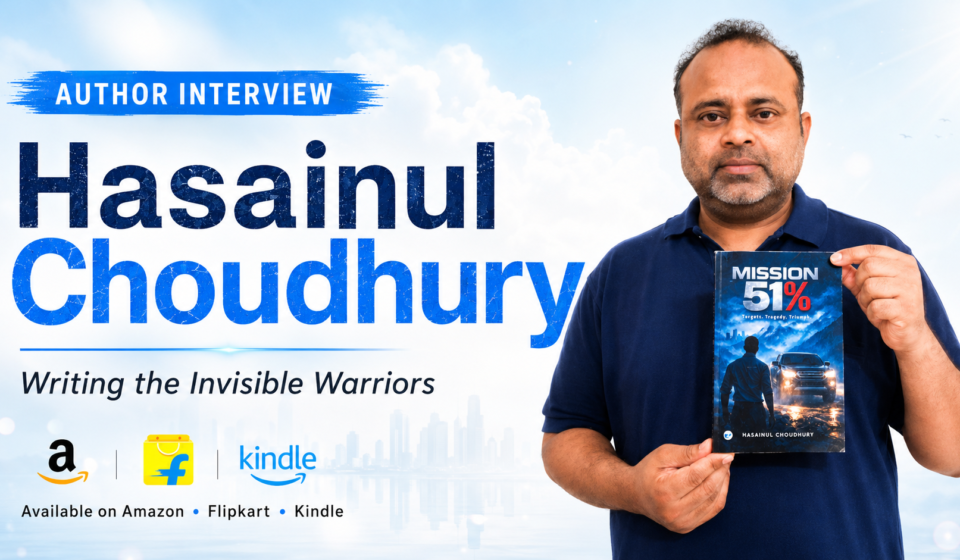

Q1. Mission 51% is not a self-help book and deliberately avoids offering frameworks or strategies. In a publishing market saturated with prescriptive business content, how do you want readers to sit with this story? What do you hope happens in them rather than to their professional behaviour?
A. I hope readers connect emotionally with the characters and reflect on the human stories behind professional achievements.
Q2. Mission 51% sits within a tradition of business fiction that attracts readers from both literary and industry worlds. Who is the ideal reader you wrote this for? When you imagine someone putting the book down and staring at the ceiling, who are they and what are they thinking?
A. The ideal reader is anyone who has worked hard toward a goal and wondered about the personal journey behind success.
Q3. Readers who have experienced impossible targets, defective products they were expected to sell anyway, or institutional betrayal of their integrity will recognise themselves in Arjun with uncomfortable precision. Have you received responses from readers in that position? What have those conversations felt like?
A. Yes. Many readers have shared how the story resonated with their own professional experiences, and those conversations have been meaningful.
Q4. The novel ends with achievement and opportunity for Arjun — but with Isha gone and the system intact. Some readers will experience that ending as hopeful. Others will experience it as hollow. Which reading did you intend — or did you build the ending to sustain both simultaneously?
A. I intentionally left room for both interpretations because life often contains hope and loss at the same time.
Follow-up: Is an ending that refuses to resolve its own central question a literary choice or an honest one?
A. It is both. Literature and life do not always provide simple answers.
Q5. Chapter 1 reads like the opening sequence of a film. The novel has been described as cinematic throughout. Have there been conversations about screen adaptation, and what medium do you feel would serve the story best?
A. The story’s cinematic nature has sparked interest, and I believe it could work well as either a film or a series.
Q6. The themes of Mission 51% are universal beyond the automotive sector and beyond India. Which international markets feel most resonant to you? Where in the world is there an Arjun right now?
A. Arjun could exist anywhere people work hard under pressure while striving to serve customers and achieve meaningful goals.
Q7. You wrote about an industry from the inside, with real product failures and real institutional patterns rendered through fictional characters. Has anyone from the automotive industry recognised themselves or their situations in the novel? And if so, what have those conversations been like?
A. Many readers from the industry have related to the themes and emotions, though the characters and events are entirely fictional.
Q8. The novel is published under your real name with your website, social media, and full professional identity attached. Did you ever consider a pseudonym, given the proximity of the fiction to real industry experience — and what made you decide to own it publicly?
A. I chose to publish under my own name because I wanted to stand openly behind the story as a work of fiction.
Q9. The preface says the book began with a memory, not a message. After writing it — after giving shape to Arjun, Isha, the Turbo Cheetah, the broken leg, the mission achieved at enormous cost — has a message emerged for you that wasn’t there at the beginning?
A. Yes. Success is most meaningful when achieved with integrity, empathy, and respect for people.
Q10. Writing fiction about institutional failure, personal loss, and the cost of professional ambition requires a particular kind of emotional exposure. What did the writing process take from you — and what, if anything, did it return?
A. It demanded time, reflection, and emotional investment, but it returned clarity, perspective, and creative fulfilment.
Q11. Mission 51% has a specific genre identity — business thriller and fiction — that you are clear about. It is not self-help, not management theory, not memoir. Why does that distinction matter to you, and what does it mean for how the book is read?
A. It matters because readers should approach it as a story about people, choices, and consequences rather than a business manual.
Q12. Arjun’s story ends at a threshold — a new opportunity, a new chapter, but also a man permanently shaped by everything the mission cost him. Is there more of his story to tell? Do you know what happens to him after the final page?
A. Every ending opens the possibility of a new beginning. For now, I am happy to let readers imagine what comes next.
Q13. Are you working on a next book? Will you stay in the territory of Indian business and industry, or does the next project take you somewhere different in form, setting, or emotional register?
A. I am exploring new ideas and stories, while continuing to focus on human experiences and meaningful themes.
Q14. Final question — and we ask it last because the answer is always the most honest: if Mission 51% accomplishes only one thing in the world — shifts one perspective, starts one conversation, makes one invisible person visible — what do you most hope that one thing is?
A. I hope it helps readers recognise and value the people whose efforts often remain unseen behind every achievement.
Disclaimer for each interview:
Mission 51% is a work of fiction. All characters, organisations, products, incidents, and events are fictional. Any resemblance to real persons, companies, or events is purely coincidental.